
(or the Frankish, short-handled throwing axe)
Those of you who have read Blood Feud (book 1 of my Rebellion trilogy (though keep an eye out for book 2: Uprising in early 2025)), will be aware of Agatho, Thegn Oslac’s Frankish champion-cum-bodyguard-cum-huscarl.
If, as well as reading the book, you were also paying attention (award yourselves 2 points if so), then you will know that Agatho’s weapon of choice is a pair of short-handled throwing axes that he keeps in his belt, and which he uses to pretty devastating effect on an all too regular basis.
‘Like many of his people, Agatho eschewed the use of sword or spear. He didn’t always carry a shield, even. Instead, he was a master of the axe. Not only did he have a pair of short-handled throwing axes that he kept stuffed in his belt at all times, but he also possessed a heavy two-handed battle axe. He was deadly with both. He could hit a running man’s head from twenty paces nine times in ten, and those who saw him swinging his battle-axe in great arcs around his head would have thought him possessed by some demon.‘
Blood Feud. Paul Bernardi, 2024
Contrary to what some might think, quite a bit of thought went into this character. I was looking for someone a little unhinged, but who was also an elite warrior; kind of like a ‘Viking’ Berserker if you will. Making him a Frank, an orphan and former slave, opened the door for plenty of character development opportunities.
Agatho hails from what used to be known as Francia (i.e. the realm of the Franks) from which we derive the modern nation of France. Francia began its rise to prominence under Clovis (ruled 488-511) as a region centred around the Rhine and Meuse rivers; at its 9th century peak – under Charlemagne – however, the kingdom comprised most of France, the Low Countries, Germany and a good portion of Italy.
One of the many factors that contributed to the expansion of Frankish rule was their military prowess, a part of which, in turn, was down to their weaponry, amongst which the throwing axe – or Francisca – played a prominent role. So, as a kind of tribute to Oslac’s most fearsome, most deadly and most accomplished warrior, the rest of this article will focus on the – admittedly niche – subject of this awesome and versatile weapon.
ORIGIN
As with most things from the Early Middle Ages, there’s not much that can be called unequivocable fact. Consequently (and this is a large part of why I enjoy writing in this period), there is often a need to fill the void with reasoned supposition and justifiable likelihood. The francisca is no exception to this rule.
The first recorded use of the term francisca appears in a book written by Isidore of Seville (560 – 636): Etymologiarum sive originum. In it, he describes the word as a name that was used in the region (i.e. an area of Spain that was then under Visigothic rule) to refer to these axes on the basis that they were used “by the Franks.” Not a wholly unreasonable point, to be fair.
At the time of his writing, however, the weapon had most likely been in use for two, or maybe even three, generations at least; there is reference to it having been used by King Clovis.
Nor is it known for how long these axes were in common usage, or when they ceased to be for that matter; though they are known to have featured during the reign of Charlemagne (768-814). The likelihood is, however, that they began to be phased out (as a throwing weapon, at least) with the improved development of other missile-type weapons such as the bow and the crossbow.
By the time of the 1060s (the setting for my trilogy), I would doubt whether the francisca still had many adherents at all. As such, I like to think of Agatho as a bit of a throw-back, a man who appreciates the finer things in life; indeed, the kind of bloke who, nowadays, might spend many hours on a Sunday tinkering with a classic car from the 1960s. I can imagine him bemoaning the lack of craftsmanship in the modern age and saying how they ‘don’t make them like this anymore.” He’s a man who appreciates the old ways and rues the gradual erosion of such ancient skills.
‘ “Cost a small fortune those axes, as you can only find them in France. Your Saxon smiths lack the skill to achieve the perfect balance; though I reckon Eldbert might come close to be fair.” ‘
Uprising, Paul Bernardi 2025
DESIGN AND CONSTRUCTION
The francisca was blessed with a distinctive design. As primarily a throwing weapon, the emphasis would have been on weight and balance so that the axe would fly true to its intended target, arcing end over end as it did so.
The head was typically made of iron, one end of which would have been thick enough to accommodate an eyehole (through which the wooden handle would be fitted). Conversely, the opposite end would have been hammered flat to form a curved blade, which was then painstakingly sharpened to a keen edge. Looking at the axe from side on, you would note that the top of the iron head was curved: either convex or S shaped.
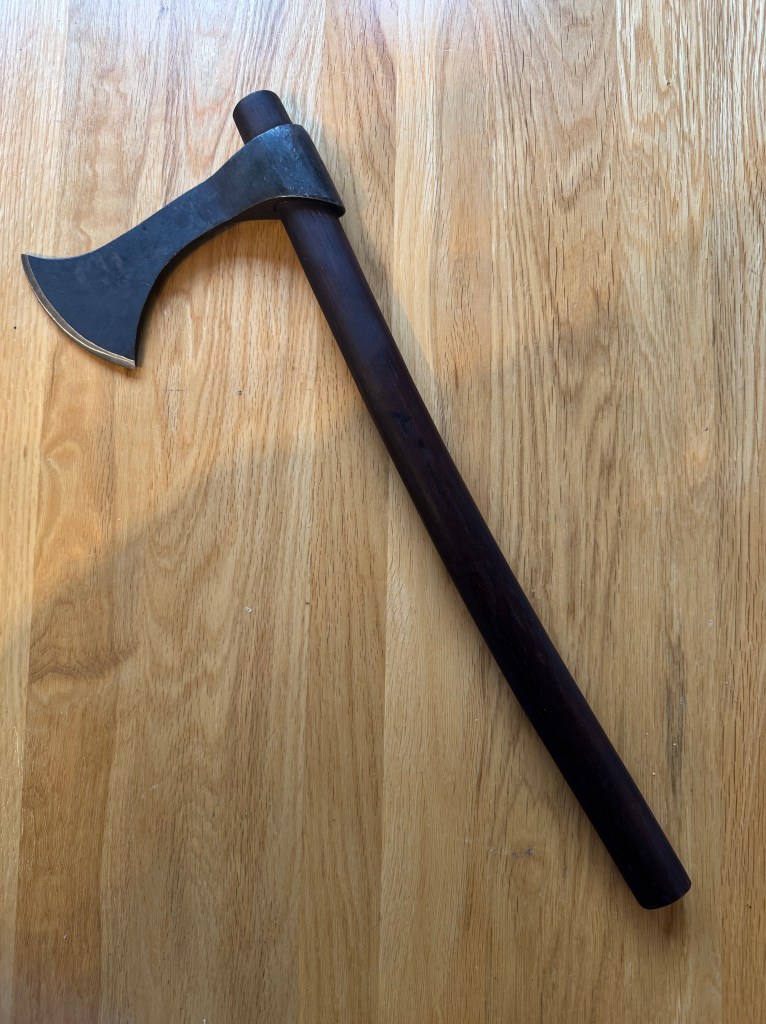
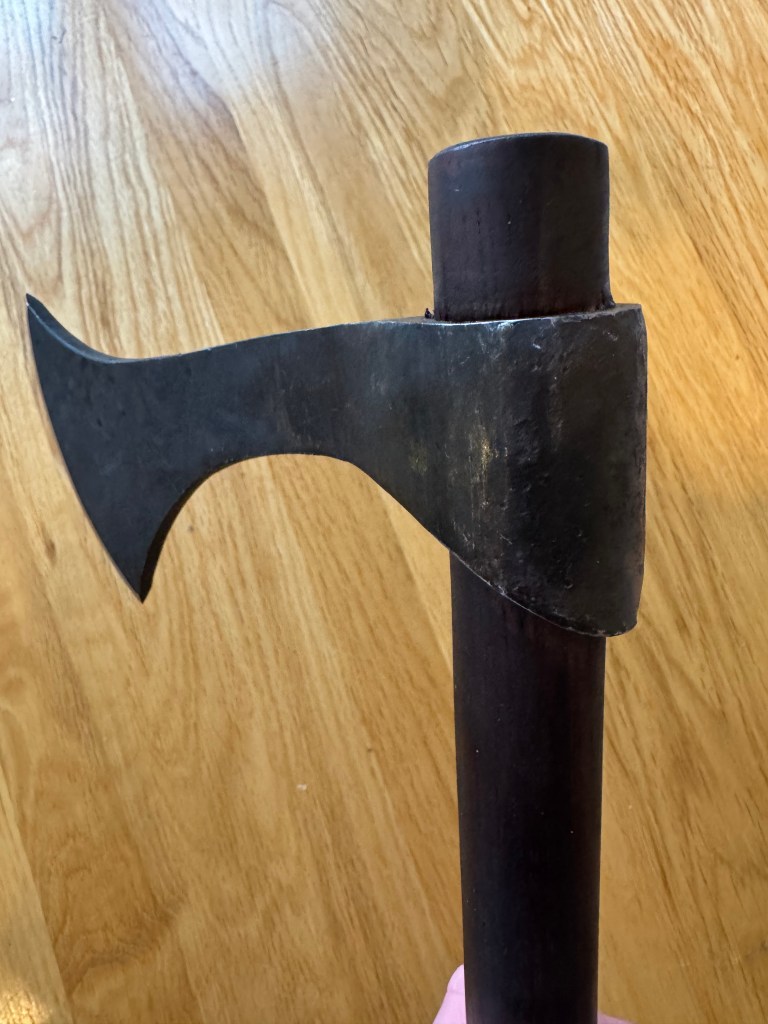
The wooden shaft – about 40-45 cms in length – was also made with a slightly convex curve which, when added to the heavy iron head, allowed the weapon to be thrown with greater accuracy and force. You can imagine standing there – frozen with fear – watching this axe spinning through the air towards you until the force of the blade split your skull in two. Perhaps your last thought, as you soiled your trews, would have been to admire the exquisite craftsmanship and aerodynamic design.
Note: should you be so inclined, there are a few videos on Youtube that show how a francisca might have been made using traditional methods. The Swede with the Iron Maiden poster in his forge was particularly illuminating.
USAGE
As stated above, the francisca’s main function was to be a missile. Whether in a static shield wall, or when charging an enemy, the Franks would hurl a volley of axes at their opponents as they closed to within effective range (say 15-20 yards). Such a salvo might easily disrupt a defensive formation or shatter the impetus of a charge.
A more targeted use might also be made, in terms of a single, enterprising warrior using their axe to take out a key target, such as an enemy commander, in the heat of battle. A far from impossible task with someone of Agatho’s calibre.
‘Placing his boot on to the corpse’s chest, Agatho bent down to lever his axe from where it had lodged itself before cleaning both weapons on the man’s cloak.
“Wish you’d been there to see that one, Oslac. Hit him square in the head, I did. A full twenty paces away. While he was running at me, too.”‘
Blood Feud. Paul Bernardi, 2024
But throwing was not their only use; the francisca was also remarkably effective as a close quarters weapon. Though not as powerful as the Danish two-handed battle-axe, the head of the francisca’s could still deliver crushing blows that would be enough to cleave skulls, break bones and crush helms.
Its curved blade could also be put to good use as a hook to be placed over an enemy warrior’s shield. Using the axe thus to pull the shield down, would leave the poor wretch horribly exposed to the spearmen in the second rank.
In summary, the francisca was a deadly and versatile weapon in the hands of a trained killer. I hope you will not begrudge me a little artistic licence so that I could to bring them into my story. I’ll conclude by giving Agatho the Frank the final word, showing just how highly he prized his fransicas.
‘…the knight’s expression had changed; now it was frozen in shock as he toppled sideways out of the saddle, one of Agatho’s throwing axes embedded in the back of his skull. Startled, the dead man’s horse reared up on its hind legs, its hooves narrowly missing Oslac’s head. With no rider to control it, the beast bolted away down the path, dragging its rider alongside, his left foot hopelessly tangled in the stirrup.
“Bring my ******* axe back here, you bastard.” ‘ Uprising, Paul Bernardi 2025

 Paul Bernardi
Leave a comment