
In its 2000-odd year history, covering 266 popes, only 1 (to date) has been of English descent, something for which Henry VIII must, presumably, bear some degree of responsibility. Even so, a strike rate of less than 0.5% is poor, no matter what the circumstances.
So, what do we know about this one man who hit the proverbial jackpot? And, following the death of Pope Francis, what are our chances of finding the net a second time?
Pope Adrian IV (also known as Hadrian – presumably by those who had been brought up not to drop their Hs) held the Papal See from 4th December 1154 to his death on 1st September 1159. His name at birth (probably in or around St. Albans in c.1100), was Nicholas Breakspear (or Brekespear).
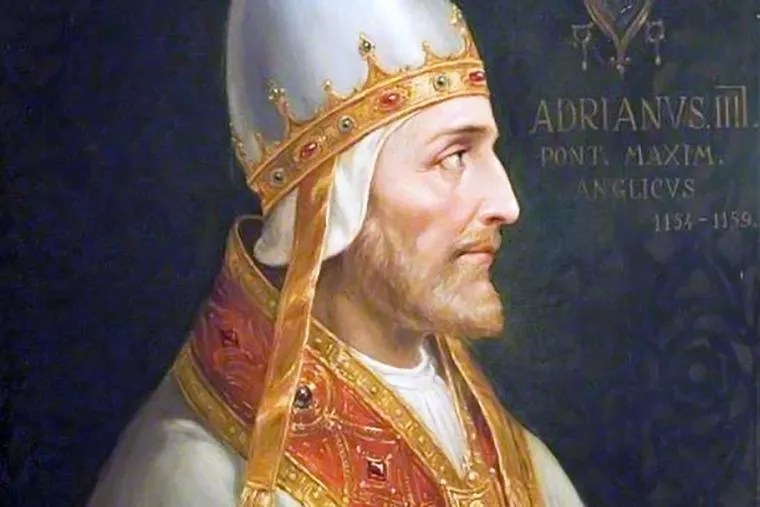
As is often the case, little is known about Nicholas’ life before his election to the papacy, with pretty much every ‘fact’ open to some degree of challenge. As is sometimes the case, a previously unknown person who rises to prominence can often have their early history ‘back-filled’ after the event, which seems to be the case for Nicholas – not least by the monks of St Albans Abbey who were happy to claim him as their own. It is perhaps not surprising, therefore, that things may have been ‘talked up’.
Received wisdom, however, suggests that he was the son of Richard Breakspear. Coming from what appears to be a relatively humble background, Nicholas received only a basic education but still managed to find his way to Arles in southern France. There, he studied canon law before being appointed to a position at the Abbey of St Ruf in Avignon, where he soon became Abbot.
Once again, details of his time at St Ruf are hazy at best, but it is recorded that Nicholas travelled to Rome at least three times during his tenure, supposedly summoned there to discuss complaints from his monks about his overbearing behaviour. It seems that, while in Rome, Nicholas came to the attention of Pope Eugenius III, apparently for his excellent leadership qualities. For whatever the reason – whether his abilities or to appease the monks of St Ruf (or perhaps, both?) – the Pope promoted him to the position of Cardinal-Bishop of Albano, a sub-diocese of Rome (about 15 miles distant). By any measure, this represents a remarkable progression and perhaps hints at the qualities that Eugenius apparently had recognised.
From there, Nicholas undertook a number of missions on behalf of the Pope. Notably to Catalonia in 1149 where the war to reconquer Spain from the Muslims was at its height, and thereafter to Scandinavia in 1152, where he served as Papal Legate and made great strides in reorganising the church and setting up cathedral schools.
On his return to Rome in 1154, Nicholas found that Eugenius had died the year before and that his successor had also died just a few weeks before. Not much is known about how Nicholas won the election (to become Pope Adrian IV), other than the suggestion that it was a unanimous decision. Was it an accident of coincidence (the right man in the right place at the right time?). Or was he genuinely chosen because of his leadership qualities were in great demand at a time of stark political turmoil in Rome, in Italy as a whole and with the Holy Roman Empire under the famed Emperor, Barbarossa.
I do not intend – within the confines of this article – to go into detail about the events and achievements of Adrian’s papacy, but, in terms of his legacy, it could be said that whilst he may not have rivalled some of the popes who came after (e.g. Innocent III), he was a significant improvement on those who had come immediately before. Whilst he may not have driven a massive reformist agenda (he was limited to an extent by the political landscape at the time), he was at least a safe pair of hands that could steer the papacy through the choppy waters and thereby establish a foundation on which others could then build (and be grateful for).
Papal Election 2025
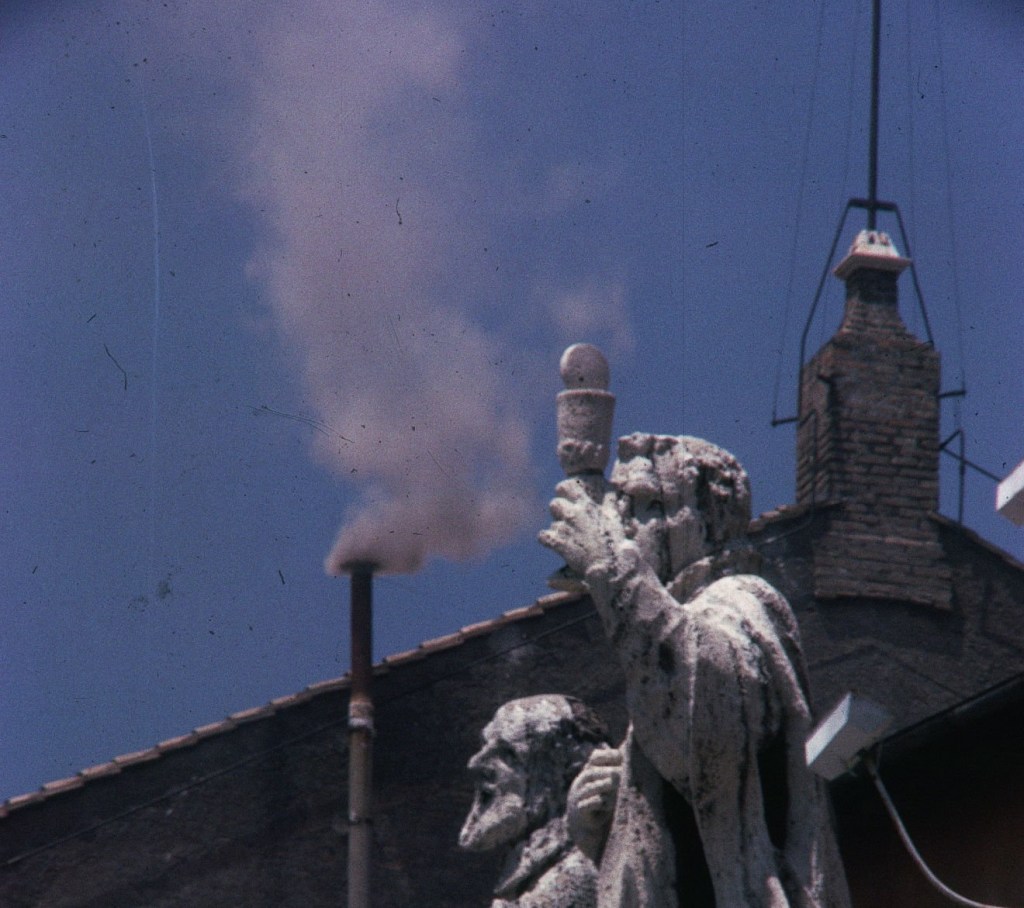
Following the death of Pope Francis, Cardinals will soon be gathering in the Vatican to begin the process of electing a successor. But what are the chances that the new pope will hail from England (or even the United Kingdom)? If it were like the Olympics, we would surely be long overdue after more than 850 years.
(By the way, if you want to gain a flavour of how the whole papal election thing works, you could do worse than read Conclave by Robert Harris or watch the recent film adaptation starring Ralph Fiennes and Stanley Tucci (to name but 2); one of my films of 2024).
There is a gathering movement that the next Pope should also come from outside of Europe, reflecting the church’s continued expansion beyond its traditional heartlands. That said, the smart money is apparently on a candidate from Italy (which would mark a surprising shift in tone, given that only 217 of the previous 266 popes have been ‘Italian’).
Anyway, stranger things have been known – hell, we even did quite well in the 2022 Eurovision Song Contest. So, who are the runners and Ryders (crumbs!) from these shores?
Cardinal Vincent Nichols (79): current Archbishop of Westminster (and thus Head of the Catholic Church in England and Wales). Apparently wanted to be a lorry driver when he was kid, but ‘got the calling’ while watching Liverpool FC as a teenager. Presumably in those pre-VAR days the Kop End had to pray for a penalty!
Cardinal Timothy Radcliffe (79): previously Head of the Dominican Order (the first Englishman in its 800-year history). A very popular man and ally of Pope Francis and thus in with a chance in respect of continuing the latter’s works. Has apparently ruled himself out of the running, but then self-deprecation always looks good on the CV.
Cardinal Michael Fitzgerald (87): a Cardinal since 2019, he has a reputation for building bridges and understanding between different faiths. Too old to vote, it has to be said that age may count against him in the race for the top job.
Cardinal Arthur Roche (75): From Leeds (which raises him in my estimation), he was previously being touted as being on a fast-track to high office. Also, as a veritable whippersnapper compared to his rivals, he may well have the stamina to last the course, though his status as a Vatican official (an ‘insider’) may hold him back. In conclusion, whilst it appears that England is unlikely to double its tally this time round, one of the above may be worth an each-way bet*.
* Disclaimer: Don’t blame me if you lose your money. After all, what do I know?
 Paul Bernardi
Leave a comment