
An apology: this article is a little longer than my normal offerings!
All images are public domain.
Most readers of this blog will have heard of Sutton Hoo; a good number of you may even have visited the site. Since its discovery in 1939 near the coast of Suffolk in East Anglia, it soon became apparent that the Sutton Hoo ship burial (dated to the first half of the 7th century), was one of the most important finds in English, if not world archaeology. The value of the light it helped cast on an otherwise darkened period of the history of these islands is inestimable. Also from the very beginning, there has been continual speculation about for whom the burial was intended. However, rather than follow that well-trodden path, my aim in this article is to look at the site (and its most likely occupant) in the historical context of what the Venerable Bede called the kingdom of the East Angles.
Before I do that, however, just a brief synopsis of the site, for those who may not be familiar with it. Sutton Hoo (literally, southern farmstead/settlement on the hill) refers to an Anglo-Saxon cemetery that was in use in the 6th and 7th centuries. It is located on the banks of the River Deben (specifically on its tidal estuary), a busy trading and transport hub in those times, with close links to the continent.

In all, there are around twenty barrows (i.e. Mounds), many of which have yielded several fascinating finds (where they have survived the attention of historical grave robbers). But it is Mound 1 around which most interest is centred. Excavations here revealed hundreds of iron rivets that indicated a ship burial (the wood had long since vanished). The vessel contained a rectangular, plank-lined chamber in which a body (again, eroded but detectable from chemical analysis) and many wonderful grave goods had been placed.

Such was the wealth and extravagance of the finds, it was clear that the grave must have been for someone hugely important in the region, quite possibly even a king. While there is no definitive proof of who was buried there, for the purposes of this article I will go along with the fans’ favourite: King Raedwald of East Anglia (died c.624/5).
Sidenote: If only we could find a pair of underpants with a name tag sewn in the back by the dead person’s mum. Anyone else remember having those in the 70s? Apparently, unintentional (I hope) pant-swapping was rife in primary schools back then.
So, who was King Raedwald and what was his place in history?
The key source from which we learn about Raedwald is Bede’s Ecclesiastical History of the English People (731 CE). We learn from Bede that Raedwald was the son of Tytila who was in turn the son of Wuffa (from whom the Anglian peoples of the region took their name: the Wuffingas). We do not know when Raedwald was born, but he is believed to have ruled East Anglia from c.599 to 624 – a truly pivotal time for the early Germanic kingdoms.
Sidenote: East Anglia was one of 7 main kingdoms in this era, collectively known as the Heptarchy; the others being Wessex, Mercia, Northumbria, Kent, Sussex and Essex.
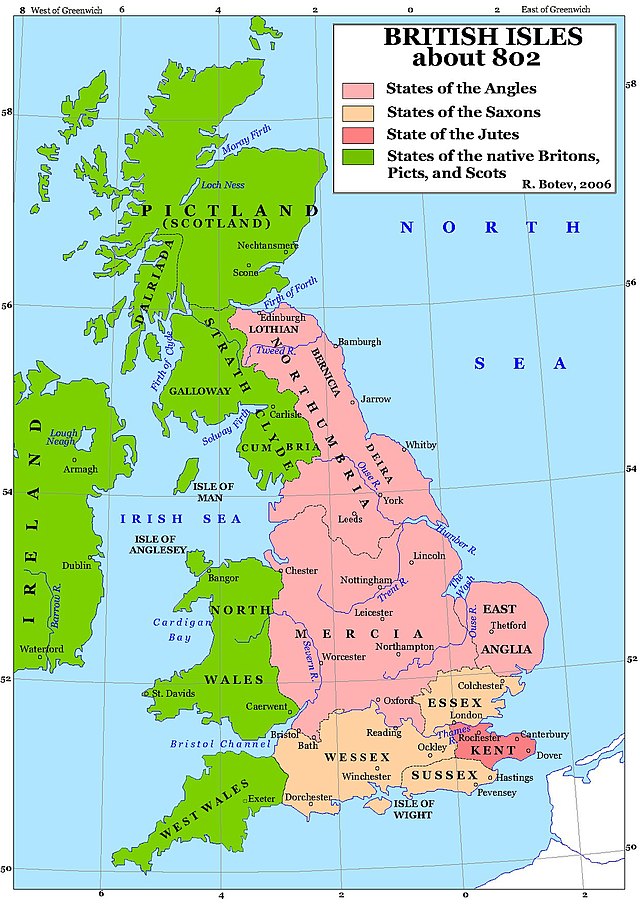
Raedwald’s relationship with Kent
At various times, one or other of these kingdoms held a loose ‘overlordship’ over some or all of the others. At the time Raedwald came to power, that role belonged to King Aethelberht of Kent. It was no accident that it was Aethelbert to whom Pope Gregory sent Augustine and his monks to effect the conversion of the heathen English (in the 590s). A lot of his power and wealth derived from Kent’s close ties to the wealthy Kingdom of the Franks (both geographical – it’s just across the channel, and familial – Aethelberht had married a Frankish princess, Bertha).
East Anglia’s proximity to Kent meant that Raedwald fell into the orbit of its influence, evidence of which can be seen from the fact that Raedwald was baptised in Kent with Aethelberht standing as his sponsor/Godparent. What better way to demonstrate that overlordship than by being the instrument by which the East Anglian king was to be granted eternal life in Heaven (though it didn’t always work out as we shall see below).
When Aethelberht died in 616, the mantle of High King (a.k.a. Bretwalda [or Briton ruler]) passed to Raedwald. It is worth noting that, of the 7 High Kings listed by Bede, Aethelberht is perhaps the odd one out in that we have no record of any battles fought (or indeed, won) by him. By contrast, force of arms played a huge role in enabling Raedwald to wrest the title from Kent, allowing him to exert his influence beyond his borders more readily than Eadbald (Aethelberht’s successor) could, despite the latter reigning for 26 years.
Raedwald and Religion
This is where our hero’s story becomes really interesting, not least in terms of how Bede relates the tale (and what he does and – more importantly – does not say).
As mentioned above, Bede says – almost in passing – that Raedwald had been baptised in Kent (likely to have been around 604), as part of a likely powerplay by Aethelberht (i.e. Raedwald may have felt compelled to accept the same new religion that his overlord had recently adopted).
Note: it was also around the same time that Aethelberht oversaw the baptism of his nephew, Saebert (King of the East Saxons) and the creation of England’s second bishop, Mellitus, in London (after Augustine in Canterbury).
But whereas Saebert adopted Christianity to the exclusion of all other gods, Raedwald seems to have had a far more ambivalent attitude in that, when he returned home, he set up a Christian altar in the same temple as his existing pagan ones. Bede, of course, saw this as an abomination but, if we were to put ourselves in Raedwald’s 7th century boots, it also feels like a sensible and logical approach (especially if he had not grasped every facet of Augustine’s preaching).
We should also be careful to avoid projecting our 21st century morals onto this period. I daresay when the Romans arrived, a similar approach was taken in terms of adding gods like Jupiter and Mars to the existing native pantheon. It was convenient to do so, and avoided unnecessarily upsetting your ‘betters’.
A few other factors should also be taken into account that may help explain Raedwald’s mindset:
When Augustine’s mission first arrived in Kent, Aethelberht made them stay on the Isle of Thanet (a proper, actual isle at that time), as if they carried a dangerous infection. Then, when it was time to meet, the king insisted on being outside, lest he be overcome by their magic indoors. And remember, this is despite Aethelberht having been married to a Christian woman from Francia for c.20 years. I kid you not. Small wonder therefore that Raedwald might have wanted to tread warily.

Secondly, the involvement of the respective royal wives is interesting. Despite his marriage to Bertha, it still took Aethelberht 2 to 3 years after Augustine’s arrival to convert. In contrast, Raedwald was married to a pagan woman (frustratingly, we don’t know her name), who – as I shall show below – was no shrinking violet. It feels very likely to me that a). she would have argued vehemently against abandoning the old gods and b). that Raedwald set great store by her opinion and advice, and he did not like to upset her too much.
If you ask me, therefore, Raedwald achieved a very practical compromise; enough to appease Aethelberht but also not to annoy his wife.
Sidenote: Although Bede covers the anti-Christian backlash that followed the deaths of Aethelberht and Saebert in 616 (their sons restored the pagan gods, showing how fragile Augustine’s hold was at this time), he doesn’t mention how, between 616 and 627 (when Edwin of Northumbria converted), Raedwald’s hybrid altar could well have been the only ‘functioning’ Christian place of worship in England. A last thread of a very slender rope by which the fortunes of Augustine’s mission hung, if you will. Perhaps his role in accepting / tolerating the new religion should be re-evaluated.
Another sidenote: In the case of Essex and Northumbria, Bede tells us that a Roman monk went to each of those kingdoms to help spread The Word (Mellitus and Paulinus respectively). But with East Anglia, he is silent. I wonder if, given the apparent (in his eyes) failure of Raedwald’s conversion, it didn’t suit his narrative to mention it. Surely, one would have been sent?
Raedwald and Edwin: the exiled prince
Talk of Edwin provides a neat segue into the next key episode in which Raedwald (and his queen) played a key part. Edwin – one of the heroes of Bede’s narrative – had fled into exile from his native Deira (the southern portion of Northumbria, centred around York) when his northern neighbour (Aethelfrith of Bernicia) had conquered his father’s lands. For the next 10 years or so Edwin sought refuge in a number of places: Gwynedd (possibly), Mercia and, finally, East Anglia. Throughout this time, Aethelfrith was ever on his heels.
When Edwin was Raedwald’s guest (c. 616), Aethelfrith sent messengers to the East Anglian king asking and then demanding (via bribes and the threat of war) that he hand Edwin over to him. At first, Raedwald resisted – as you might expect from a man who was about to eclipse Aethelberht as overlord of (southern) England. But after the 3rd attempt and, doubtless aware that Aethelfrith was a mighty warrior and the one person who truly rivalled him for power, Raedwald succumbed.
Fortunately, a member of Edwin’s household warned the exile of the imminent danger but the prince refused to flee, saying that he would not break faith with his host as that would besmirch (my new favourite word) his own honour.

It was at this vital moment that Raedwald’s (nameless) queen came to the rescue, reminding her husband that by accepting Edwin as his guest, he was sworn to protect him and that to abandon him in his hour of need would leave an indelible stain on the king’s honour. She therefore persuaded her husband to renege on his agreement with Aethelfrith. Naturally, Raedwald knew what must follow so he mustered his army which then defeated and killed Aethelfrith at the battle of the River Idle (c.616).
As a result, Edwin was installed in Deira and was soon able to unite it with Bernicia, (perhaps also with East Anglian troops provided by his ‘overlord’, Raedwald).
Raedwald’s Queen: the power behind the throne?
One of the features of Bede’s Ecclesiastical History is that he rarely champions the cause of women. Those few he does mention tend to be Christian relatives of kings who go on to found monasteries and do good works (Abbess Hild at Whitby being a fine example). Raedwald’s queen is a case in point; she is not part of his agenda and therefore, she doesn’t warrant being named (though he surely would have known it).
Despite his best efforts, however, he has – unintentionally – shed light on the role played by an early Anglo-Saxon queen (assuming Mrs. Raedwald was typical of her kind). Reading Bede (and other sources, to be fair), you could be forgiven for thinking it was a wholly male-dominated world (it pretty much was, of course, but not perhaps as much as portrayed). In general women were only portrayed in the roles of diplomatic pawns (peace-weavers in dynastic marriages) or as maidens of Christ, furthering the spread of Christianity through their abbeys.
However, with Raedwald’s queen, we get a glimpse behind the monk’s carefully constructed curtain.

Firstly, she was a key voice in shaping the way in which Christianity was subsumed within the existing religious practices of East Anglia (rather than replacing them). Bede tells us that she – along with “certain evil teachers” – turned Raedwald around. But, as mentioned above, it wasn’t necessarily that the king rejected Christianity, but rather that it was added to the existing pantheon.
Also, without her influence, Edwin would have most likely been killed. In which case, Aethelfrith keeps hold of Northumbria and Christianity does not reach his kingdom (at least not for a while yet). Think what that would have done to Bede’s narrative – if it would have even existed, given him being a native of that region. A case could be made for her being one of the most important characters in his whole story. And still, incredibly, the sod couldn’t be arsed to tell us her name.
Raedwald and Sutton Hoo: the clues
Disclaimer: What follows below is a lot of circumstantial mumbo jumbo (on my part), which attempts to position some of the finds from the ship burial in some sort of historical context. So, please bear with me and come along for the ride…
NB. None of this nonsense provides any definitive proof that Raedwald was the man buried in the ship. It’s that lack of name-tagged underpants again, you see.
From a religious perspective, the burial is an eclectic mix of old and new. The ship burial concept has strong pagan overtones, as does the plethora of (regal and military) grave goods (something that largely stopped with the switch to Christian burials).
Most interesting of all, however, are the 8 silver bowls with cruciform patterns and the pair of silver spoons, one inscribed with Paulos, the other Saulos (hope you can all remember your Sunday school lessons…). These look for all the world like baptismal gifts and their presence in a pagan burial setting could well indicate an adult convert who had not let go of the old ways (or whose people hedged their bets on his behalf when it came to his burial). It wasn’t worth the risk of upsetting the old or new gods, so both were included.
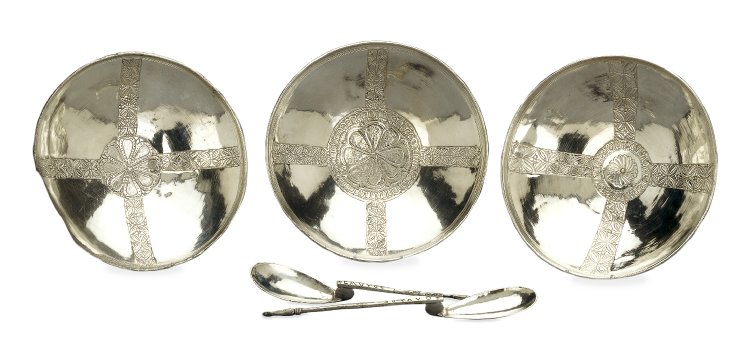
Then there is the whetstone/sceptre and iron standard – symbols of kingship, both. There is a passage in Bede (talking about the strong rule of King Edwin) which states that when travelling around his kingdom, he was preceded wherever he went by a royal standard, known to them as a thuf (Latin: tufa). It is definitely tempting to see the latter of these two objects as Raedwald’s own version thereof.
The coins: a purse was found which contained 37 gold, Frankish coins, 3 more blank (i.e. unstamped) coins and 2 small ingots. As well as being critical in helping to date the burial to the 620s, their significance has been the source of much debate. One common interpretation is that they represent payment for the oarsmen who would row the ship across to the underworld.
I have also seen speculation – which I absolutely love – that these coins (and possibly some of the other gold artefacts) could have been part of the bribe offered by Aethelfrith to hand over Prince Edwin. It is, of course, impossible to prove but is a totally delicious idea, nevertheless. A symbol of Raedwald’s wealth but also (not so) subtly flipping Aethelfrith the middle finger even in death.
All in all, Sutton Hoo will always command a significant place in our pre-conquest history (now rivalled by more recent finds like the Staffordshire Hoard). What makes it particularly fascinating, however, is the ability to link archaeology to the historical record, something that happens all too rarely.
 Paul Bernardi
Leave a comment