
It’s one of those ‘what if’ cases that often pops up in history: how might things have been different had King Edmund Ironside not died in November 1016?
But who was Edmund, and why should we bemoan his all too short (6 months) time on England’s throne? And most importantly of all, how did he acquire such a belter of a name?
Background
The third son of King Aethelraed II (known as Unraed – or, ill-advised) and his first wife, Aelfgifu, Edmund was born sometime before AD 993 (when his name first appears as a witness – along with his two older brothers – to one of his father’s charters).
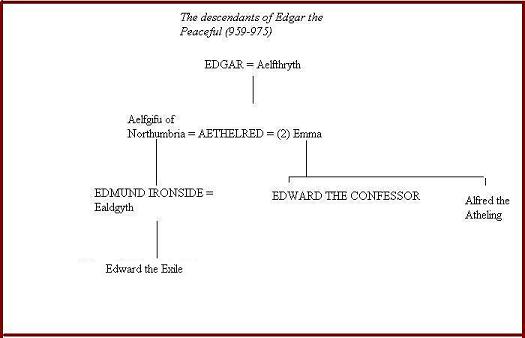
During his childhood, Edmund developed a close bond with his eldest brother (Aethelstan) that would eventually see them unite in opposition to their father’s chief adviser, Eadric Streona (i.e. the Grabber / Grasper) – very much the pantomime villain of this piece.
The strength of this bond can be seen in that Aethelstan, who had amassed a large collection of weaponry over the years, bequeathed his most prized possession to his younger brother on his death: a sword purported to have once belonged to King Offa of Mercia.
(Note: an original copy of Aethelstan’s will has survived to this day. He died in June 1014, pre-deceasing his father).
Formative Years, or how not to rule!
As many of you may already be aware, King Aethelraed’s reign was dogged by almost continual calamity, much of which was his own doing (or, at least, aided by the poor counsel of his advisors).
Yes, the kingdom had been under significant threat from the Danes, but it was the king’s response to such issues that marked him out from his ancestor, Alfred the Great. While Alfred had resorted to paying off Danish raiders at times, he had done so as part of a carefully constructed and coordinated campaign of resistance which ultimately enabled his son and grandson to expand the borders until Aethelstan was able to claim to be (the first) King of what we would recognise today as England.
With Aethelraed, however, whilst the taxation demands might have been similarly draconian, there was no end product to show for it. As such, large sections of the English nobility eventually lost patience in having to pay through the nose for no obvious benefit. Many of them began to wonder whether accepting the rule of a Danish overlord might be better (if not, cheaper) in the long run.
Aethelraed also had to contend with the growing animosity of his two eldest sons towards Streona, as well as their perception that their father’s new wife, Emma of Normandy, was scheming to ensure that the king’s sons by her (Alfred and Edward (later to be King Edward the Confessor)) would be favoured over them in the succession.
To cut a long story short, all the problems that had been bubbling away finally boiled over in 1013. What took place between then and late 1016 would shape the future of England for generations to come.
Invasion (Part 1): the Danes are coming
Having launched a number of punitive raids since 1002, the Danish king, Sweyn Forkbeard, returned to England in 1013, but this time at the head of an army of conquest. Largely as a result of his inept governance over many years, Aethelraed’s support melted away to such an extent that, come December, Sweyn was being acclaimed King of England in Gainsborough, while Edmund’s father was heading for ignominious exile in Normandy.
It is not known what happened to the brothers, Aethelstan and Edmund, at this time, but they are not generally thought to have followed their father abroad. Warriors both and in their prime (both in their early to mid twenties), they may well have decided to remain in England to organise resistance to the Danes.
As it was, fate intervened when Sweyn died less than six weeks into his reign (see my earlier article on the interesting manner of his death).
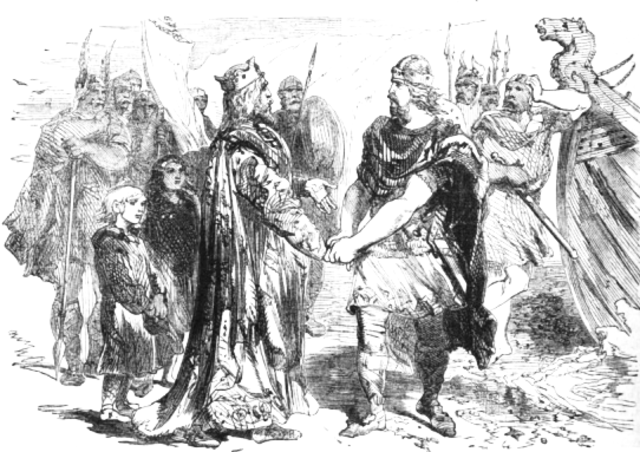
This proved to be the trigger that enabled the English nobles to relocate their balls. In scenes that spookily echo 1215, they duly sent word to Aethelraed that they would welcome him back, as long as he were ‘to rule them more justly than before’. With the appropriate promises provided on both sides (a forerunner of Magna Carta, if you will), the former king duly returned during Lent.
Knut, meanwhile, had been elected king by the Danes and all those loyal to him or his deceased father. Nevertheless, Aethelraed’s return – along with troops new and old (Olaf Haraldson and Thorkell the Tall, respectively) – took him by surprise. The Saxon king’s combined forces fell upon Knut before his own army was ready. Many were killed while Sweyn’s son was forced to flee back to Denmark.
Unrest: Daddy issues
If anyone thought that all would now be rosy in the English garden, they were sadly mistaken. Whilst Knut might have been sidelined (for the time being), the underlying problems at the heart of Aethelraed’s court remained: mostly centred around Eadric Streona.
It was a trio of deaths over the next few months that conspired to throw everything into a state of turmoil once again.
First of all, around midsummer 1014, the king’s eldest son, Aethelstan, died, having become mortally ill. Two of the beneficiaries of his will were the brothers, Sigeferth and Morcar, chief thegns of the Five Boroughs (think East Midlands) and key figures at the king’s court. They were also the sons of Ealdorman Aelfhelm who had been murdered by Eadric in 1005, thereby showing the king’s eldest son politically aligned the anti-Eadric faction.
Months later (spring 1015), Eadric had those two brothers murdered as well (completing the set in his ‘murdered families’ game). Making things worse, it was done with the apparent connivance of the king, for Aethelraed immediately ordered the seizure of their lands and also took Sigeferth’s widow – Ealdgyth – with the intention of having her sequestered in Malmesbury abbey.
This was all too much for Edmund, now his father’s heir as the eldest surviving son, and also the new leader of the anti-Eadric party. The prince quickly liberated Ealdgyth and married her himself. Taking her with him back to the Five Boroughs, he took possession of the dead brothers’ estates and also the submission of the rest of the region.
Invasion (Part 2): It’s the Danes again
What was shaping up nicely to be a father-son civil war was averted, however, by the timely (for him) return of Knut at the head of a new army. Too ill to organize any meaningful defence, Aethelraed delegated command of his army to Eadric, thereby making an alliance with Edmund all but impossible. Dogged by the usual rumours of treachery, Eadric acted true to form as he soon went over to Knut’s side, taking 40 ships with him.
Edmund was immediately on his own and on the back foot. His first attempt to raise an army to oppose Knut failed when Aethelraed refused to join. A second attempt after Christmas 1015 met with the same result. For his third attempt, Edmund went north where he managed to convince Earl Uhtred of Northumbria to side with him in ravaging Eadric’s Mercian estates. But when Knut moved to threaten York, Uhtred swiftly submitted to the Dane. It was a move he soon came to regret though, when Knut had him executed on the advice, unsurprisingly, of Eadric.
Edmund was now all out of options. All he could do was withdraw to London, where his ailing father still held on, and pray for a miracle.
Aethelraed’s death in April 1016 proved to be the unlikely answer to his prayers. Rather than being the final nail in Edmund’s coffin, it was actually something of a fillip for the Anglo-Saxons. With the father-son rivalry over, the English were able to unite under the new king. A king who soon showed himself to be far more effective in martial matters than his father.
The winner takes it all… the loser’s standing small (stop it! – ed.).
In effect, England now had two kings. Edmund, elected by the citizens of London, and Knut, acclaimed by the rest of the Witan (i.e. council). It would now be a fight to the death between the two, evenly-matched rivals.
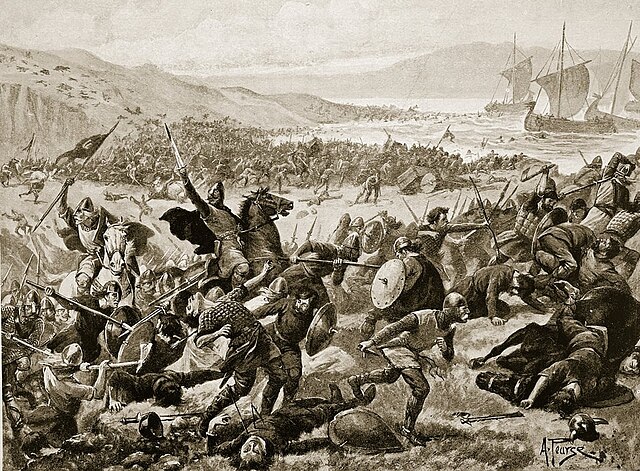
While the Danes laid siege to London, Edmund headed west to Wessex to raise an army. With these troops he fought two battles against Knut (Penselwood in Somerset and Sherston in Wiltshire), which – whilst not decisive victories – were in no way defeats for the Saxon king. Edmund then marched on London where he was able to lift the siege before then defeating the Danes near Brentford.
With his army severely battered, though, Edmund had to withdraw to Wessex to muster fresh soldiers, allowing Knut to renew his attempt to capture London. But when Edmund returned, he was able, once more, to lift the siege and defeat the Danes – this time at Otford – forcing Knut to pull back into Kent.
Such was the intensity of Edmund’s resistance, he was afforded the moniker ‘Ironside’, perhaps with some level of irony given the apparent military ineptitude of his father’s reign. The king’s success was also the signal for Eadric to switch sides once more, deserting Knut.
It was at the next battle, however, that all Edmund’s good work came undone. On the 18 October, the two sides met at the Battle of Assandun (probably in Essex), where Eadric proved yet again what a horrible little shit he really was by removing his men from the field (some say he fled, but my gut says he saw another opportunity to ensure he came out on the winning side).
Outnumbered, Edmund was decisively beaten, all but ending his hopes of securing the whole of England. To bring the fighting to an end, however, the Witan stepped in to broker a deal by which Edmund would rule Wessex and the south, while Knut would hold Northumbria and Mercia (with whomever died first ceding their lands to the survivor).
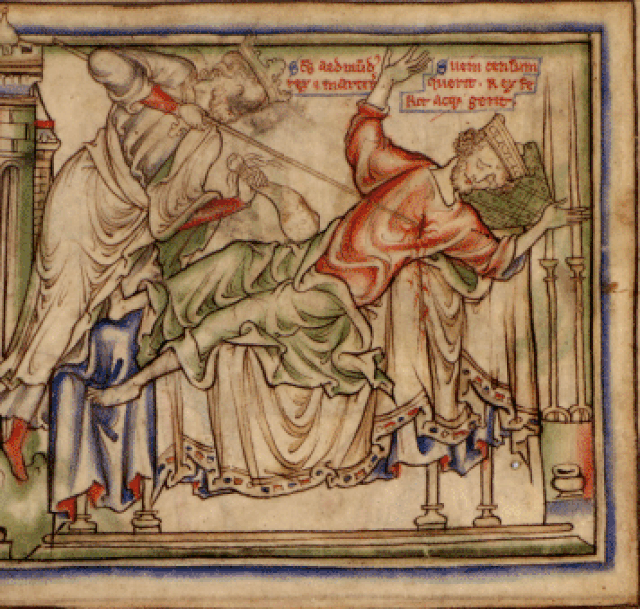
Fate had not yet finished messing with them, however, as Edmund was dead a mere month after the agreement had been signed. Whilst contemporary sources make no mention of foul play, later writers were not so shy. Adam of Bremen (writing in the later 11th century) suggested Edmund had been poisoned, whilst 12th century sources suggested – somewhat gruesomely – that the king was assassinated by an arrow, fired from below, whilst sitting on the toilet.
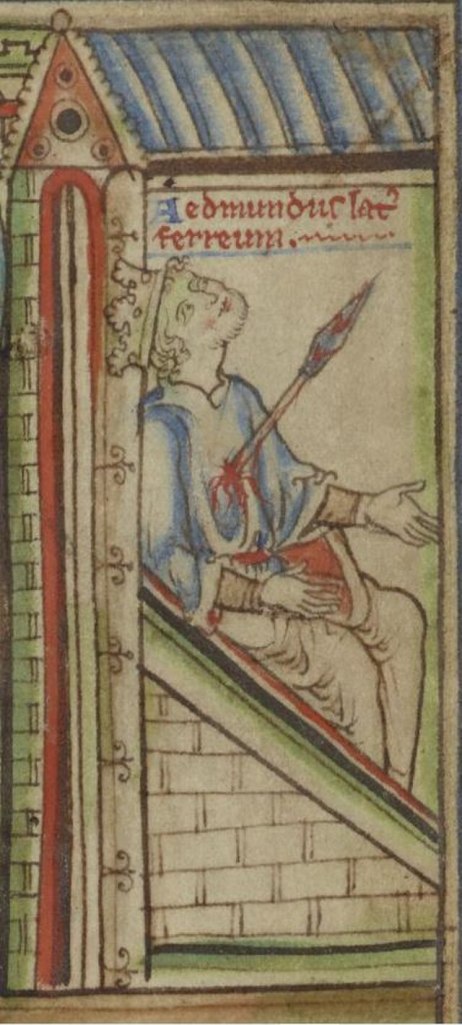
For me, whilst that is a very vivid image – the stuff of nightmares in fact – a far more prosaic and probable answer is that Edmund succumbed to wounds incurred in battle. Having fought at least five battles in the preceding six months and, doubtless being the type of leader that stands in the front rank of the shieldwall, it would not be a surprise if Edmund had received at least one wound along the way. And with medical science hardly conceived, wounds could easily become infected.
Aftermath
With Edmund dead, Knut became the sole king of England, its second Danish king (if you count his father’s 5-week rule). Through him and his two sons (by Emma of Normandy – yes, Aethelraed’s widow married the new king!), the Danes would rule England until 1042 when another of Emma’s sons (by her first marriage) restored the West Saxon royal family to the throne (Edward the Confessor).
As for Edmund’s own offspring, Knut sent his two young sons to Sweden – presumably to be murdered, only for King Olof to pass them on to Kyev where his daughter was the grand princess. Though one (Edmund) was to die (probably fighting for Prince Andrew in his coup to retake Hungary), the other (Edward the Exile) would eventually return to England in 1057 (with his son, Edgar Aetheling), as the Confessor’s likely preferred successor.
Conclusion
There is a case to be made that Edmund’s untimely death robbed him of a reputation / status as great as that of Alfred the Great or Aethelstan. His resistance against Knut was likely on a par with what the former was up against in 878 with the Great Heathen Army, and perhaps similar to the grand alliance against Aethelstan in 937. Had he lived, I wonder whether we would be adding ‘The Great’ to ‘Ironside’.
Postscript
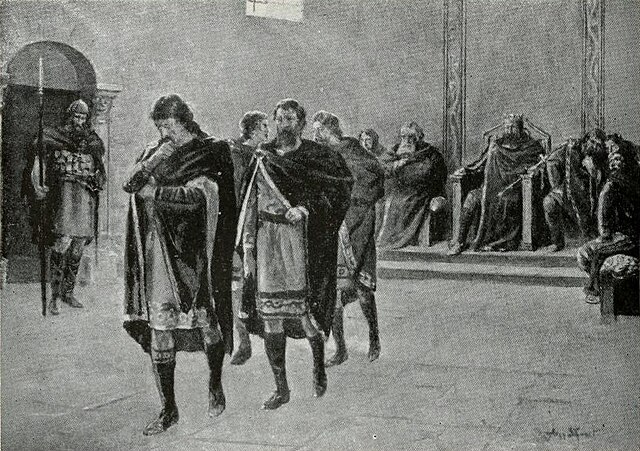
I couldn’t finish without mentioning the fate of Eadric Streona, not least because I’m happy to say that the odious toad finally had his comeuppance at the hands of King Knut. Eadric had gone to the Danish King’s court at Christmas 1017, no doubt seeking remuneration for his desertion of Edmund at Assandum which had handed Knut victory.
As recorded in the Enconium, Knut is said to have instructed Earl Eric Haakonsson to “pay this man what we owe him”. The earl duly obliged by chopping Eadric’s head off with an axe in the middle of the king’s hall. Clearly an astute man, Knut knew Streona could never be trusted.
 Paul Bernardi
Leave a comment