
NB. All images used herein are public domain.
He’s one of English history’s greatest (i.e. worst) pantomime villains, but aside from historians or enthusiasts of the era, I doubt many people will know who he was or what he did. This article will attempt to redress that balance.
To have an idea of just how bad he was, a 2005 BBC History Magazine poll named him the worst ‘Briton’ of the 11th Century. Presumably William the Conqueror came second (or did not qualify as a ‘Briton’).
Note: be ready with your boos and hisses every time he appears.
So, who was Eadric the Grasper?
Just on the nomenclature front, I should clarify from the start that the epithet ‘The Grasper’ (also sometimes rendered as ‘The Acquisitive’) is a translation of the old English word, Streona. This wasn’t his real name either; rather, it was an insulting moniker that was added later as an indicator of the kind of man he was.
Not much is known of Eadric’s early life, other than a few bare facts. He was born c.975 AD into a fairly well off – but otherwise unremarkable – family whose land holdings were centred around Shropshire and Herefordshire. He was, therefore, a Mercian. His father, Aethelric, held no titles of his own but was known to attend the court of the then king, Aethelraed Unrede (i.e. the Unready – another of those epithets that just SLAY!)
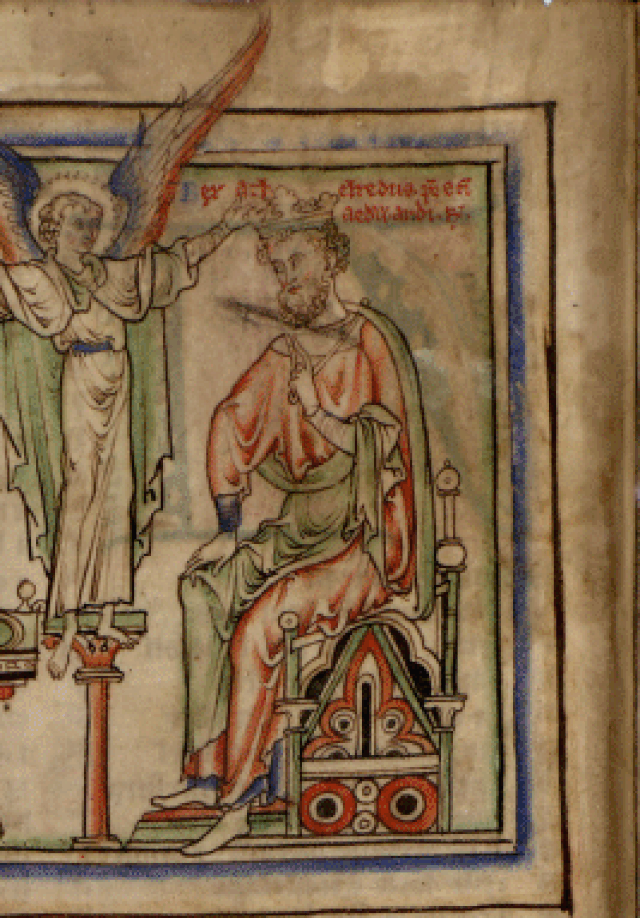
It’s worth noting that his lowly origins and subsequent rise to great power and influence as Ealdorman of Mercia may go some way to explaining the anathema that was directed against him by many chroniclers of the age. To use another modernist phrase, Eadric had refused to stay in his lane and was thus perceived and treated as an unwelcome upstart.
Political Life
His first appearance as a man of consequence occurs in 1002 when he (along with his father and one of his brothers, Brihtric) witnessed one of King Aethelraed’s charters. From there, it doesn’t take long for him to start stirring up trouble.
John of Worcester records how, in 1006, Eadric was involved in the killing (i.e. murder) of Ealdorman Aelfhelm of Northumbria. Described as ‘crafty and treacherous’, Eadric supposedly arranged a great feast for Aelfhelm in Shrewsbury. After a three or four day bender, they went into the woods nearby to hunt. When everyone was distracted, a butcher by the name of Godwine Porthund (in the pay of Eadric) ambushed and killed the Ealdorman.
In his ‘defence’, Eadric appears to have been working on the king’s orders on this occasion, though it suggests that Aethelraed had already marked him out as someone with a taste for brutal, underhand work such as assassinations. Soon after, Aelfhelm’s two sons (Wulfheah and Ufegeat) were blinded on Aethelraed’s command (presumably to stop them from seeking revenge). It is not known whether Eadric was responsible, but it wouldn’t be surprising.
That Eadric Streona was very much in the king’s good books becomes apparent over the next couple of years when firstly he becomes Ealdorman of Mercia in 1007 (a position that had been vacant since 985), and then when he marries Aethelraed’s daughter, Eadgyth, possibly in 1009. Is it too much to suggest that the king was trying to keep Eadric onside, in case he should go rogue?
If he was, then it failed spectacularly.
The Danish Conquest of 1016
Surprisingly, perhaps, Eadric remained loyal to Aethelraed up until the latter’s death in 1016. That’s not to say he wasn’t up to his usual tricks though. Having devastated Dyfed (again on the king’s orders), Eadric is recorded as having pocketed a fair bit of the resulting cash – a cue for the later nickname. Then, in 1015, we see something of a repeat of the Aelfhelm incident, when, as the Anglo-Saxon Chronicle records:
“While a great council was being held at Oxford this year, the traitorous ealdorman, Edric Streon, perfidiously invited to his lodgings two of the most considerable and influential persons in the Seven Burghs, Sigeferth and Morcar, and there caused them to be secretly murdered.”
On this occasion, however, the fallout from the killings appears to have taken on a more sinister and dangerous hue in so far as relations within the royal family are concerned. That Aethelraed was behind it can be assumed by the fact that he was quick to confiscate the lands belonging to both victims. But when he also ordered the arrest of Sigeferth’s widow, that was too much for the king’s eldest son, Edmund Ironside. The prince abducted her and married her himself, thereby becoming Lord of the Five Boroughs, in defiance of his father.
This more than anything may have set the seal on the West Saxon dynasty’s fortunes. Within four months of Knut arriving in England in 1015, Eadric had switched sides, going over to the Dane with 40 ships. With Edmund married to the widow of a man killed by Eadric, it was never going to make for a comfortable dinner party.
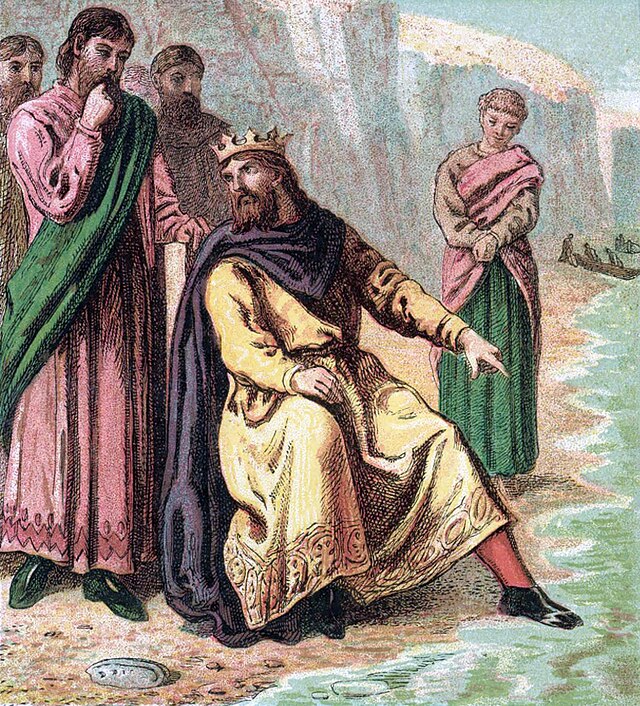
When King Aethelraed succumbed to illness (April 1016), the battle lines were drawn. London elected Edmund to be their king, whereas the Witan, possibly under some pressure, declared for Knut. Seven months of chaos and destruction were to follow.
In the first two of four (or possibly five) battles in that time, (Penselwood and Sherstone), Eadric fought for Knut. Though the outcomes were inconclusive, it did appear that Edmund had the upper hand. Then, after a narrow Danish defeat at Otford, Eadric decided it was time to be reconciled with his brother-in-law.
Quite what convinced Edmund to accept Streona back into his good graces is unclear. Perhaps his sister put in a word for him. Either way, it was a disaster waiting to happen. And happen it duly did.
Note: It’s certainly possible that Eadric was still in the pay of Knut at this point. It would explain what happens next. There is no evidence for such a ruse, however, as far as I am aware.
Battle of Assandun (October 1016)
With momentum on his side, Edmund gathered a new army and proceeded to press hard against the retreating Danes (though it is suggested that Eadric somehow contrived to delay the king long enough for Knut to rally his troops).
Matters came to a head, however, in October 1016 at Assandun (possibly Ashingdon in Essex). With Eadric in command of one wing of Edmund’s army, the stage was set for a final showdown. That was, of course, until Eadric withdrew his forces from the field (possibly as a pre-arranged betrayal, if he was still working for Knut).
The result was catastrophic. Abandoned and outnumbered, Edmund suffered a decisive defeat, though he did at least survive.
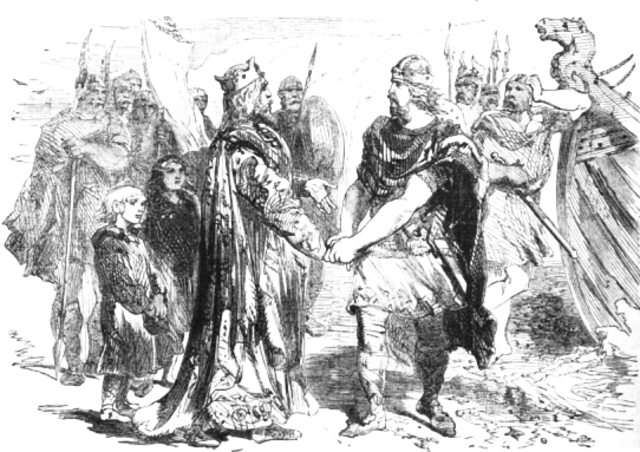
At this point, Eadric apparently turns peacemaker by arranging for the two protagonists to meet (on the Isle of Ola in the Bristol Channel). There a deal was brokered by which the kingdom was split into two parts (the north and east going to Knut, the south and west to Edmund). Whoever died first would then pass his share to the other.
It may come as no surprise that Edmund was dead within a month. Whilst there is no clear evidence of foul play, and it is quite probable that the king may have succumbed to wounds received in battle, there were rumours of Edmund having been disembowelled with a spear while on the khazi. A poignant, if not pointed end. One can only hope that if Eadric was in the cesspit holding that spear, that Edmund managed to take a dump on his head before being killed.
Aftermath: a close shave
So, having committed the greatest possible act of treason (the desertion at Assandun), Eadric must have thought he’d come up smelling of roses (rather than effluence). That Knut – in 1017 – confirmed him in his role as Ealdorman of Mercia would have been just the first of the many honours he must have been expecting.
But it was not to be. Eadric the Grasper (boo; hiss) was to meet his end later that year, at Knut’s Christmas Council in London. It was a fitting end, too; one that was truly deserved.
With his belly full of fine Christmas fayre and likely drunk on heady red wines, Eadric must have been looking forward to receiving some excellent presents from King Knut, before then dozing off by the fire. Especially when Knut ordered Jarl Eric Haakonsson to ‘pay this man what we owe him’.
Unfortunately for Eadric, rather than a nice new cloak or a shiny sword, he was instead the recipient of an axe. Through his neck.
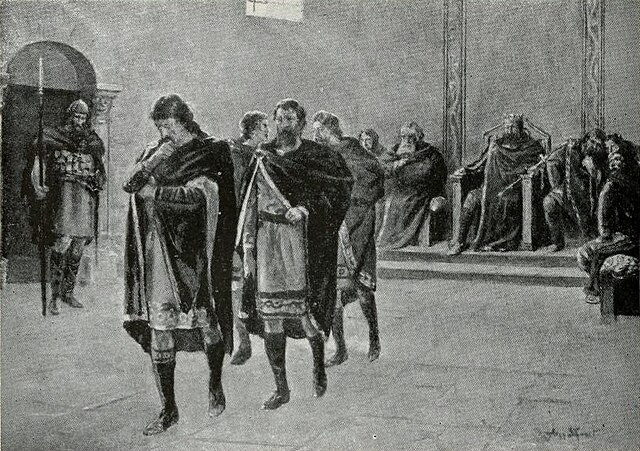
According to the Encomium Emmae (commissioned by Knut’s wife, Emma of Normandy who had – fun fact – previously been married to Knut’s predecessor, Aethelraed Unrede), Knut ordered this because Eadric had not fought faithfully for his liege lord. In other words, Knut appears to have been a little more savvy than Edmund, in that he took steps to deal with Streona before he too could become one of the Mercian’s victims.
Streona’s body was then unceremoniously dumped over the city wall, while his severed head was stuck on a pole.
So the man who – according to John of Worcester – “was indeed a man of low birth but his tongue had won for him riches and rank; ready of wit, smooth of speech, he surpassed all men of that time, both in malice and treachery, and in arrogance and cruelty” ended up reaping what he had sown.
In the view of Simon Keynes, and I can’t argue with him, Eadric acquired “a notoriety unmatched in Anglo-Saxon history for his complicity in an assortment of murders, base stratagems and acts of treachery.”
 Paul Bernardi
Leave a comment