
All images public domain
NB. The following blog contains scenes of an adult nature 🙂
This article is one of an occasional series featuring some of the lesser known kings of Anglo-Saxon England. Alfred, Aethelstan, Aethelraed II, Harold – even Knut – receive far too much attention; so it’s only fair, every now and then, to shine the spotlight elsewhere. And who better than Eadwig (also known as Edwy) who – in today’s parlance – might well be termed an absolute lad.
Who was King Eadwig and when did he reign?
Regular readers of my blog will recall that when King Aethelstan died in 939, he was childless. Not for any biological reason, but rather that he had never married. There are those (me among them) who suppose that this was deliberate. Known for his exceptional piety, the decision to remain chaste may not be all that it appears at first glance, though. Prior to his accession, he had faced considerable opposition from the West Saxon court (Aethelstan had grown up in Mercia), and it may be that a deal was struck whereby he could be king but only if he did not spawn any offspring.
Aethelstan was, therefore, succeeded by his eldest surviving half-brother: Edmund – son of King Edward the Elder and his third wife, Eadgifu. When Edmund was then killed in 946, his own two sons were too young to take the throne, so his brother, Eadred, stepped up, reigning until 955.
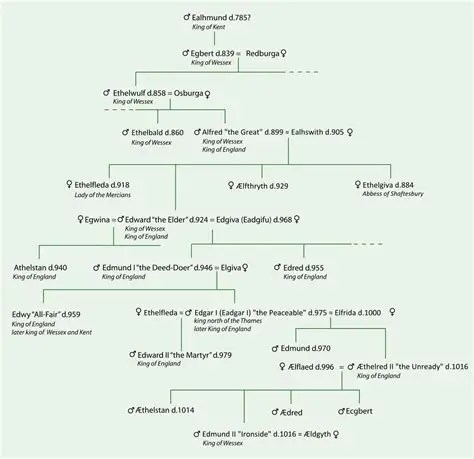
Now 15, it was the turn of Edmund’s eldest son (and Eadred’s nephew), Eadwig, to finally assume the kingly mantel. Though his time on the throne proved to be short – he died in 959 – it’s fair to say that the young lad packed a fair bit into his later teenaged years.
Feasts, Fun and Frolics
Eadwig wasted no time in making his bid to become the randiest royal roisterer of the 10th century.
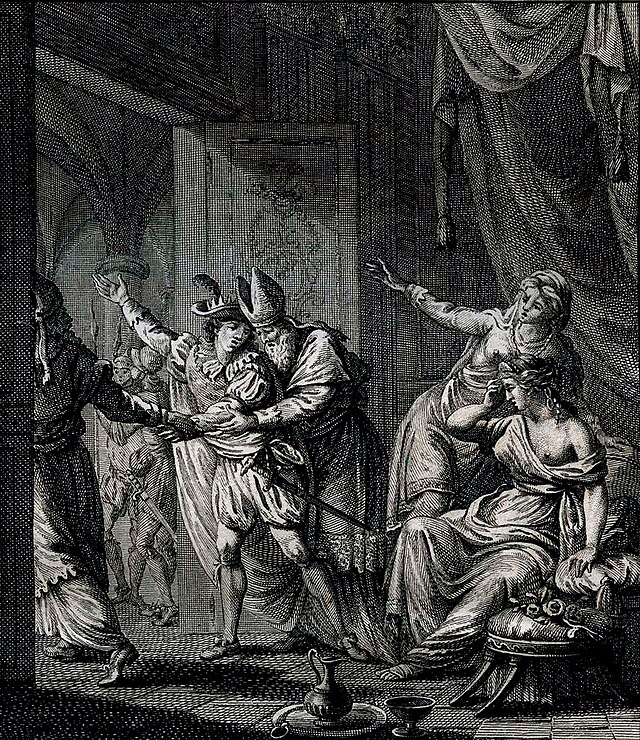
Whilst the following tale exists in a number of versions, the core suggests that, rather than remain at the feast to celebrate his coronation (I told you he wasted no time), he decided to absent himself. When it was noticed he was missing, Abbot Dunstan of Glastonbury (later Archbishop of Canterbury) went looking for him.
He was found – allegedly – in bed with not one, but two women. Worse than that, they were reputed to be mother and daughter. Being the straight-laced churchman that he was, one can only imagine Dunstan’s towering rage as he dragged the boy back to the feast (likely by the ear or – worse – by the hairs of his sideburns, like my Latin master used to do (allegedly) – yes I am that old).
However, we should perhaps note a couple of points in Eadwig’s defence at this juncture. Firstly, even though he was only 15, he had already been dubbed ‘All Fair” in recognition of his stunningly good looks, so it is hardly surprising that he would attract attention.
It is also worth noting that the younger of the two women – Aelfgifu – was his wife. Although, to be honest, I am not sure if that makes it better or worse <shudder>.
I want to break free
The other thing we should bear in mind is that, even though his reign was comparatively short, Eadwig did manage to fall out with leading church officials on a quite spectacular level: Abbot Dunstan ended up exiled to Flanders for the duration of his reign.
And, given that the church owned the majority of the pens and pencils at this time, it was unlikely that they would have much good to say about the boy. In fact, there is every chance that the story of mother-daughter threesome might have been at least embellished, or even made up. They were probably engaged in an impromptu and innocent game of twister when Dunstan rocked up…
In that vein, an alternative way to portray Eadwig would be that, rather than the tainted image presented by some of the ecclesiastics, what we find is actually a headstrong boy who lacked political maturity.
Having succeeded his uncle, Eadred, he may well have found himself surrounded by a court that was infused with older men who were not of his choosing and who – he felt – were exerting far too much influence over him.
To support this supposition, a significant amount of potentially corroborating evidence can be produced.
- Dunstan’s exile (as mentioned above). Whilst the Abbot was keen to suggest this was the result of the sordid sexual shenanigans on the day of his coronation, who’s to say that was not just a cover story intended to blacken Eadwig’s name. It’s just as likely that Eadwig wished to be rid of the killjoy.
- Eadwig took steps to curtail the power of some of the court stalwarts, notably his grandmother, Eadgifu, and Aethelstan Half-King, the leading noble in East Anglia. Both had their possessions removed, marking a desire for the new king to distance himself from his uncle’s inner circle
- In 956, Eadwig issued more than 60 land grants (i.e. charters) – a record for any European monarch that stood until the 12th century. It’s not hard to interpret this as an attempt (possibly a desperate one at that) to curry favour with a new band of nobles.
Schism
Whatever the causes, however, trouble was brewing and – at the centre of it (knowingly or otherwise) – was Eadwig’s own brother, Edgar. Aged just 14 in 957, it was clear that he was favoured by some key factions at court, perhaps those whose noses had been put decidedly out of joint as a result of their treatment by Eadwig.
Whether or not the schism came as a result of a full blown rebellion is not really known but the outcome was a division of the kingdom, in 957, into two parts: Eadwig retained the southern half (i.e. Wessex and Kent – everything south of the Thames, in effect), whilst Edgar took Mercia (including East Anglia) and Northumbria.
Such an arrangement was not wholly unprecedented; it was only one generation since Edward the Elder’s death had seen Aelfweard elected in Wessex and his – older – half-brother, Aethelstan, take Mercia.
How long such a situation could have continued can only be a matter of conjecture as – in 959 – after a reign of less than 4 years, Eadwig died. He was still only 19 years old.
As is often the case in this era (e.g. Edmund Ironside in 1016, Edward the Elder in 924 to offer just two examples), the nature of his death went unrecorded. Whilst natural causes is certainly possible, one has to wonder whether someone in the Edgar camp had a hand in it. Certainly the ‘Cui Bono?’ question points to Edgar in that he became king of the reunited kingdom and ruled (pretty successfully) for another 16 years.
Conclusion
So, whilst we would struggle to say Eadwig was a ‘good’ king, it may be a little harsh to lump him in the ‘bad’ category (at least not entirely). His main fault may well have been to get up the noses of some pretty big players who proceeded to go about bringing him down a peg or two (perhaps even to the extent of assassination).
They may also be responsible for ensuring that the main reason Eadwig is remembered today is for the famous familial fornication furore (that’s enough F words…Ed.).
That said, a (pathetically puerile) part of me really does hope it’s true!


Leave a comment