
All images are public domain
Over the last few weeks, I have been working on a contribution to a forthcoming compendium of short stories set during the 11th Century. Whilst my tale is largely based on fact, I’ve taken a sufficient number of liberties to justify the need to provide an account of the historical record (as much as it is known or can be pieced together) that underpins my tale.
It is one of the less well known stories of that era, but also one which – had things turned out differently – could have changed the course of England’s history. If nothing else, it would not be unreasonable to suggest that England might never had been conquered by the Normans in 1066 but for one single slice of shockingly bad luck.
We begin in 1016, with the first of the two successful foreign conquests of England that took place the 11th Century. In April of that year, King Æthelræd II (more popularly known these days as Æthelræd the Unready) died after a long, but troubled reign stretching back to 974. In one area, at least, the old king had been successful – fathering more than 10 children of which 8 had been boys. He was succeeded, therefore, by his eldest surviving son, Edmund, who would later (likely due to his martial prowess) become known by the rockstar moniker of Ironside.
Though he only reigned for a little more than 200 days, it was long enough for him to earn the reputation which has followed him down to today. During those months, he fought five or possibly six battles against King Knut of Denmark and though they were, for the most part, indecisive, Edmund definitely had the better of the majority of these exchanges.
That was, however, until the final battle fought in October 1016 (Assandun – likely Ashingdon in southeast Essex).

Here, Knut won the decisive victory he needed[1] to bring Edmund to the negotiating table where an agreement was forged to split England in two (with the Thames as the dividing line) with the proviso that whoever was to die first would pass their half on to the other.
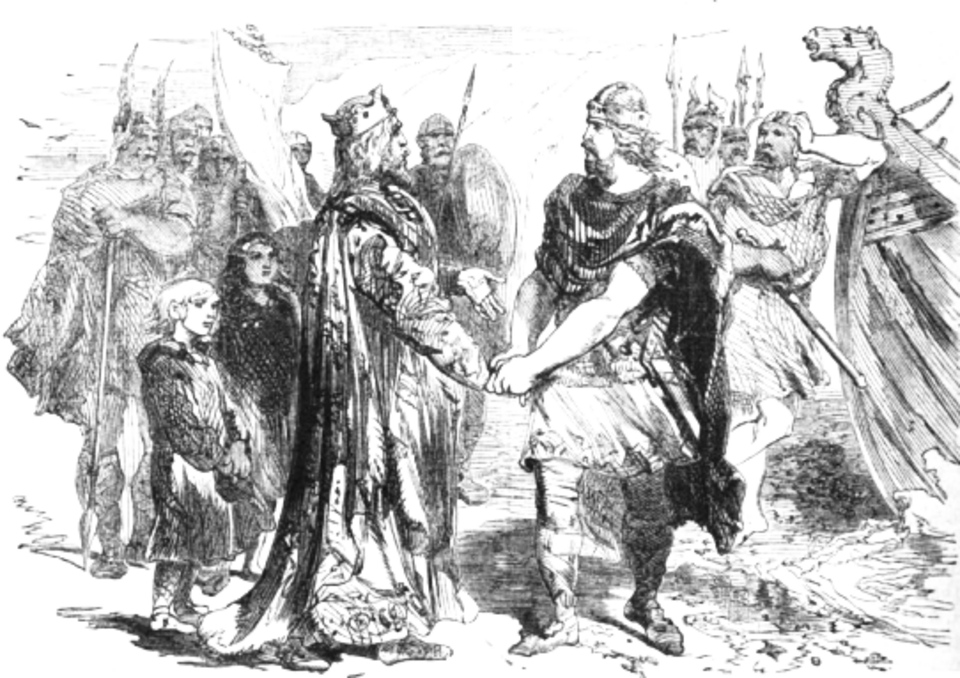
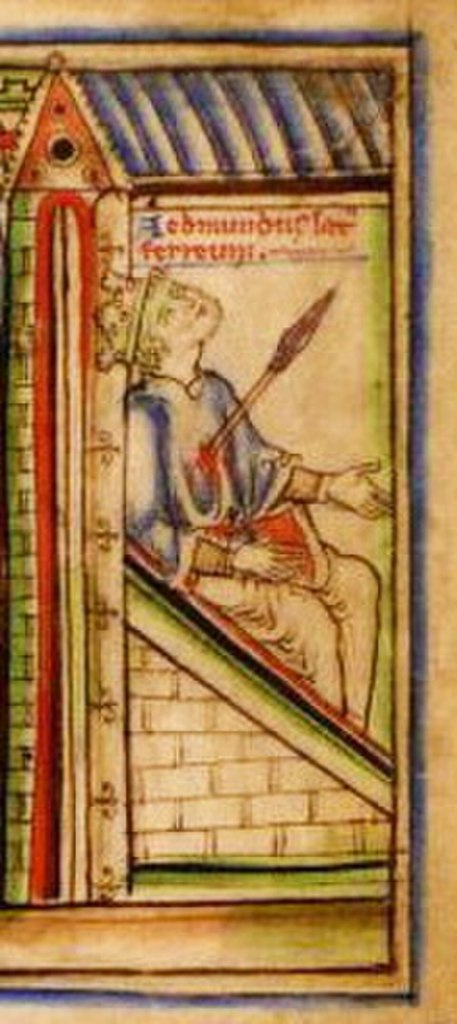
You’re one step ahead of me, I can tell. Within a month, Edmund was dead[2], allowing Knut to become king of a once-again, united England.
At his death, Edmund been in his mid-twenties (we’re not exactly sure of his birth-date: possibly 991). By his wife, Ealdgyth, he left two infant sons: Edmund and Edward, the latter of whom is the subject of my short story.
Now, you could be excused for thinking that things looked pretty grim for the boys with their father gone. Surely, Knut would not want these two rival claimants hanging around to become the centre of opposition to his rule?
And you’d be right. But, rather than just kill them (who wants child-killer on their CV after all, a lesson that Richard III might have done well to heed[3]), he contrived instead to send them to the court of King Olof Skotkonung (possibly Knut’s step-brother) with orders for the toddlers to be done in.
Olof, however, declined. Whether he was squeamish, or whether he remembered with fondness his former alliance with their grandfather, King Æthelræd, we cannot say. Possibly, it was both. Instead, therefore, he sent them away.
From this point, it becomes increasingly difficult to trace the boys’ movements over the next 40 years. All we can say with any real certainty is the following:
- They probably grew to manhood at the court of Yaroslav the Wise, Grand Prince of Kyiv. Yaroslav was married to Ingegerd Olofsdottir hence Kyiv being a likely destination chosen by her father, King Olof.
- At some point (1030s) they came into contact with Prince Andrew of Hungary (another exile at Yaroslav’s court). A bond was formed which saw them join the prince’s successful campaign to reclaim the Hungarian throne in 1046.
- Edmund disappears from the record; it could well be that he died in battle – possibly even during the Hungarian campaign.
- Probably as a result of his status (of the West Saxon royal house) as well as his martial ability, Edward was able to marry a woman of considerable standing, Agatha. Although her origins are sketchy, there is a considerable consensus that she was a relative (sister or niece) of Emperor Henry II of the Germans (i.e. Holy Roman Emperor).
- Together, they had 3 children (all born in Hungary): Margaret, Cristina and Edgar.
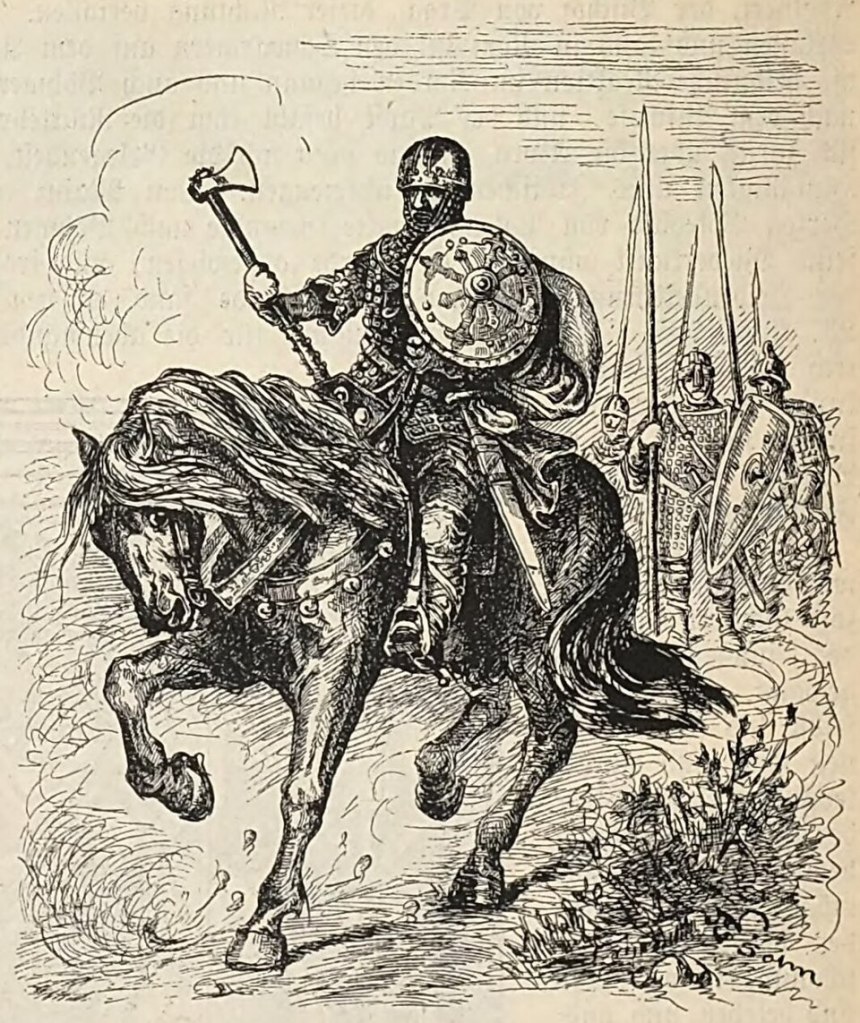
Meanwhile, back in England, things were not going great. In the mid-1050s, King Edward the Confessor (a son of Æthelræd the Unready by his second wife, Emma of Normandy) had been on the throne since 1042 but was yet to produce an heir (even though he had been married to Edith (Harold Godwineson’s sister) for the best part of a decade). He was also now c.50 years old and thus the likelihood of becoming a father before he died was reducing every passing day.
Thoughts were therefore turning, quite understandably, to the succession. Leaving aside the Danish interlude (1016-1042), England had always been ruled by a scion of the Royal House of Wessex, but with that line apparently about to become extinct, various great lords would have been jockeying for position, not least of which were Duke William of Normandy and Harold Godwineson[4].
But then in 1056, everything changed. I would love to know how the English court came to be aware that Edward the Exile (Edumund Ironside’s son and the Confessor’s step-nephew) was alive and well in far off Hungary. It must have been quite a moment (think dropping of jaws, slapping of foreheads and much earthy swearing).
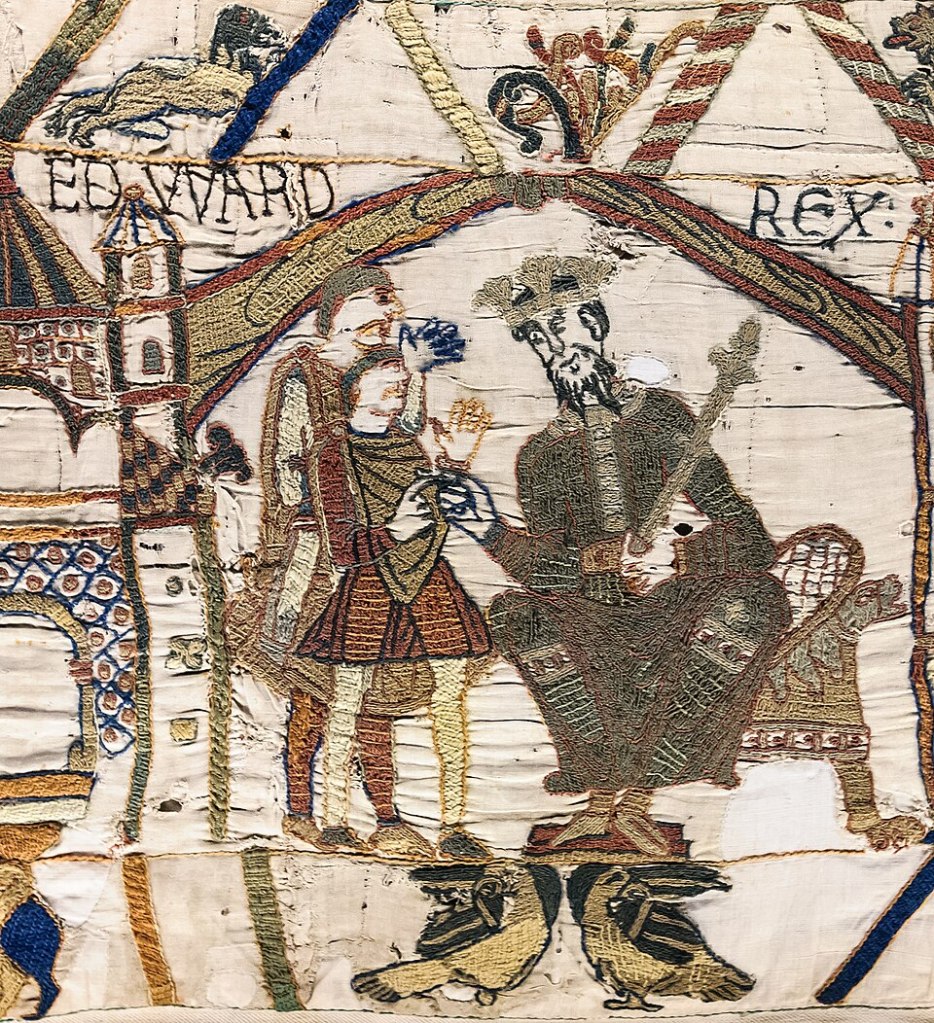
With this news, it seemed that the hunt for a successor was finally over (as well as having the added benefit of putting rowdy upstart claimants back in their boxes (at least for now)). Envoys were dispatched to the court of the German emperor in 1054, but this initial attempt to negotiate a return was unsuccessful. A second mission – in 1056, possibly under Earl Harold Godwineson’s leadership – met with more success, facilitating Edward the Exile’s return to England in April 1057.
Quite what the ‘foreign’ prince made of the crowds that had assembled to greet him at the docks in London, we cannot know. For their part, however, they would have witnessed the landing of a Saxon-looking man in his forties, richly-dressed but in strange attire, and likely speaking little, if any, English. A weird experience that was no doubt passed down orally through the generations:
‘Did I ever tell you the time when…?’
‘YES, Grandpa. Now shut up and pass the turnips.’

For the Confessor, it will have been a huge weight off his mind. The pressure was off; he could forget about his lack of a son now that this long lost nephew had returned. The remaining years of his life had taken on a much shinier sheen.
His euphoria was to be short-lived, though. Within days of his arrival on England’s shores, Edward the Exile was dead; he wasn’t even around long enough to meet his uncle. All the planning, money, time and effort had been for nothing, it seemed. The path to the throne of England was once-again wide open.
It is one of those great ‘what-if?’ debates to imagine what might have happened had Edward survived to succeed his uncle. Assuming the Exile might have ruled for a good ten years before his own death, it would not be unreasonable to assume – given his reputation from Hungary – that he might have been able to stabilise and strengthen England to the point where there would be no invasions in 1066. On top of which he actually had a son who would have been old enough to succeed him when the time came. The whole trauma of the Battle of Hastings and the subsequent carnage and brutality that ensued, could well have been avoided.
Footnote
Eagle-eyed readers will have noticed that I referenced the fact that Edward the Exile had three children, one of whom was a boy: Edgar the Ætheling. After the Exile’s death, he (c.5 years old in 1057) was adopted by his great-uncle, King Edward the Confessor, and there is no reason to question the fact that the old King saw Edgar as his eventual successor.
However, come 1066, a number of factors were to conspire against the boy, enabling Earl Harold to (effectively) usurp the throne. Firstly, Edgar was still a teenager. He was also still a ‘new-comer’ and thus lacking any significant support for his cause, unlike Harold (who was a wealthy and wily politician who could have eaten the boy for breakfast). Thirdly, with a threat of possible invasion looming, it would be understandable that the Witan (council of nobles entrusted with electing the new king) would have plumped for the proven general over the young royal pup (esp. if many of its members were ‘Harold’s men’).
It is interesting to consider this against the supposed death-bed utterings of Edward the Confessor wherein Harold (leaning in close to hear the last croaking words of the dying man) swore that Edward had bequeathed the throne to him. On the other hand, it was elsewhere recorded that Edward had merely entrusted the kingdom and his wife to Harold’s protection (the assumption being ‘until Edgar is old enough to rule’).
This is what – in my humble opinion – makes Harold the ultimate opportunist. It would have been perfectly possible for Harold to have been the power behind the throne (as he had been for King Edward’s final years), given command of the armies to deal with any threats (from within or without). But I rather think that Harold was not about to be side-lined by a kid with a funny accent.
NB. If you would like to find out more about some of the characters in this blog, you’ll be glad to hear that I have other articles available:
King Edmund Ironside
Eadric Streona
Edgar Ætheling
[1] NB. A victory that was only possible due to the perfidy of Eadric Streona (the Grasper), Ealdorman of Mercia, who withdrew his forces from the battle, leaving Edmund massively outnumbered.
[2] There is no record of the cause of Edmund’s death, though rumours did later begin to circulate, the most foul of which was a suggestion that a relative of Eadric Streona had killed the king ‘at his toilet’. Yes, he hid in the cesspit and shoved a spear up the royal arse. It is more likely, however, that Edmund died of wounds (or infection from those wounds) acquired over the course of his many battles.
[3] Note: whatever the truth, this comment is just a bit of fun!!
[4] William based his claim on the fact he had been promised the throne when the Duke had visited King Edward the Confessor in 1051, though no English source mentions this (unsurprisingly). Harold, meanwhile was the most powerful, most wealthy noble in England whose sister was married to the king.
 Paul Bernardi
Leave a comment