
In my new series of novels (set amid the reign of King Æthelstan), I very much position him as a ‘good guy’. I mean, to have ruled for roughly fifteen years and to have achieved all the things he did (not just winning battles), he had to be doing something right. But is that too simplistic?
In answering that question, we have to remember that the Anglo-Saxon period demanded a level of ruthlessness and brutalality which – whilst relatively normal at the time – can offend our 21st century mores. We should always be wary of the urge to project modern sensibilities backwards.
It’s the classic case of not being able to make an omelette without breaking eggs. The question we should, perhaps, ask ourselves, though, is whether Æthelstan was breaking the same number of eggs as everyone else of that era.
In this article, I shall attempt to shed some light on this issue by looking at the cases of two of his (roughly 12!) siblings.
Setting the Scene
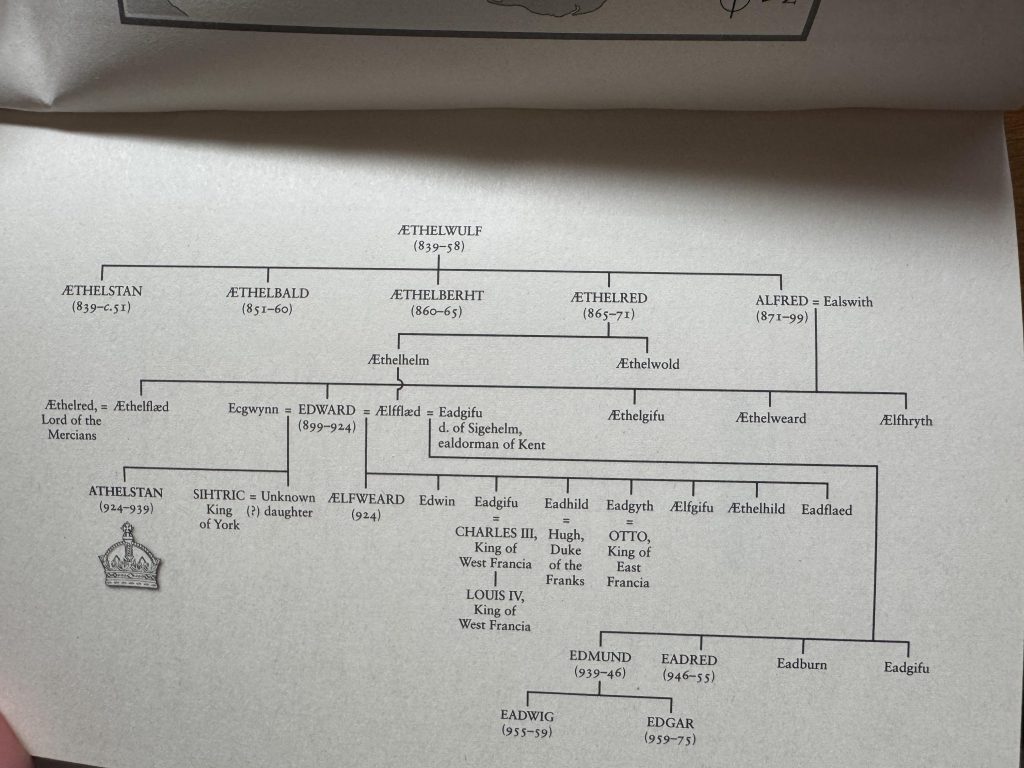
Born somewhere around 894, Æthelstan was the eldest son (in fact, eldest child) of King Edward the Elder who had succeeded Alfred the Great in 899 and who ruled until his death in 924. Very little is known about his mother, Ecgwynn, except that, come 899, Edward had taken a second wife, Ælfflæd.
We have no idea whether that meant Ecgwynn had died or she had been ‘put aside’. My suspicion, however, is that – now he was king – Edward’s thoughts would have turned to securing his realm, especially from internal challenges such as his cousins. It may be reasonable to assume, therefore, that Ælfflæd was, politically speaking at least, an upgrade in terms of being better connected with more powerful West Saxon nobles.
Either way, Ælfflæd soon fulfilled her primary responsibility by providing Edward with children (eight of them in all, including two sons: Ælfweard and Eadwine). And this is where things – for Æthelstan – started to go wrong.
Succession Planning
As the eldest son, Æthelstan might have expected to be first in line to succeed his father. It wasn’t set in stone, of course, that the eldest son would accede (his grandfather, Alfred, had succeeded his brother to the exclusion of his nephews), but unless there was a very good reason not to, the Witan (council of nobles) could generally be expected to elect him.
Ælfflæd, however, appears to have had other ideas, though whether she was driving the agenda or carrying out the instructions of her more powerful kin is unclear. She may even have been entirely innocent but I do somehow doubt it.
Whatever the case, when King Edward died in 924 (near Chester, incidentally), the West Saxon Witan elected his second son, Ælfweard, to succeed him.
So, how did this apparent break from tradition come about?
At some point early on in his life, Æthelstan left the royal court of Wessex. Though we only have a 12th century source for this (albeit one that was likely reusing other – now lost – older texts), the accepted supposition is that he was sent north to Mercia to be brought up by his aunt, Æthelflæd, Lady of the Mercians. It would prove to be excellent preparation for his future life as king (politically and militarily) but its primary effect at the time was to remove him from Wessex for more than twenty years.
We don’t know the reason why he was sent away, but it’s not a great stretch of the mind to suggest that Ælfflæd wanted him out of the way so that the focus would be wholly on her boys. After all, what mother (ambitious or otherwise) would not have wanted the best for her children?
Another key point in favour of Ælfweard was that he had been ‘born in the purple’. That is, he had been born to a ruling king (whereas Æthelstan was born when his father was still just the heir to King Alfred’s throne. In many eyes, not least those in Ælfflæd’s faction, this placed him above his older, half-brother.
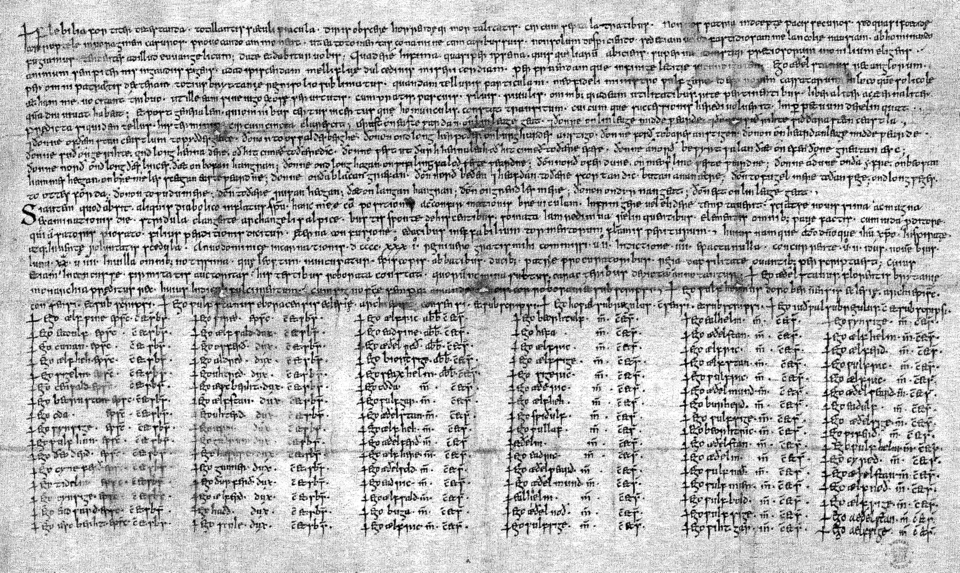
That Ælfweard was being preferred over Æthelstan can be seen in the witness lists of King Edward’s charters, wherein Ælfweard’s is the first name to appear after Edward (and ahead of Æthelstan) – a sure sign of his perceived higher status.
The Stage is set
Given all of the above, it comes as no surprise then that when King Edward died in 924, a split formed between Wessex and Mercia. A split that threatened to undo much of the work (the gains won by a united front pushing the Danes back) that had been achieved since Alfred’s time.
While Wessex elected Ælfweard (pretty much as expected), Mercia declared for Æthelstan (again, not unexpected if he had been living there for 20+ years). It is hard to know what would have happened if that situation had persisted, but a civil war between the two kingdoms could not be ruled out. The only winners in that scenario would be the Danes.
As it was, however, just 16 days after Edward’s death, Ælfweard was also dead. As is often the case in these circumstances, the primary sources are incredibly frustrating. Not one of them has anything to say about how or why he died. In fact, only one source bothers to mention that he died in Oxford.
So what are we to make of this? It cannot be denied that Ælfweard’s demise was incredibly convenient for Æthelstan; it left him as the only realistic candidate for the throne of Wessex. Ælfweard’s young brother, Eadwine, was likely still in his teens at this point, whereas Æthelstan was close to thirty and a proven general and warrior. He was also now king of a combined Wessex and Mercia.
It’s possible that Ælfweard died of natural causes; disease and infection were a constant worry. But such things – whilst not impossible – would be less likely for a young man in his early twenties (and one who presumably had the advantage of a (comparatively) good diet). We will never know for certain, but a finger of suspicion must surely point towards Æthelstan, or agents in his pay. Murdering his brother – most prominent rival for the throne – would be an unusual step but not all that extraordinary, perhaps.
What about Eadwine?
The fate of Ælfflæd’s other son is similarly shrouded in mystery. With just the barest of facts known, we are once again forced to speculate as to the cause of his fate. His fate, in fact, seems to be the one thing that is known to us – i.e. that he drowned at sea in 933. To work out why he was on a ship in the first place, however, we have to try to piece together tiny fragments from a variety of sources; a task which still leaves the jigsaw only half finished.
The E version of the Anglo-Saxon Chronicle along with Henry of Huntingdon are no help; they merely say that Eadwine was lost to the waves. Simeon of Durham, however, (at some remove from the events it must be said) suggests that ‘Æthelstan ordered his brother to be drowned at sea’.
A more interesting and wholly independent tale can be found in the annals of the Flemish abbey of St Bertin. They record how the monks of that abbey were well received in Wessex in 944. And although they mistakenly refer to Æthelstan as their host (he had been dead for 4-5 years by then), they do tell us a few things worthy of note:
- That the king (who would actually have been Æthelstan’s third brother, Eadmund (eldest son of King Edward’s third wife, Eadgifu – keep up!)) was well disposed to the Flemish monks on account of their having cared for the bones of his brother, Eadwine
- That Eadwine had been obliged to put to sea after a failed coup in Wessex (though we don’t know if he was the instigator, the proposed beneficiary or both)
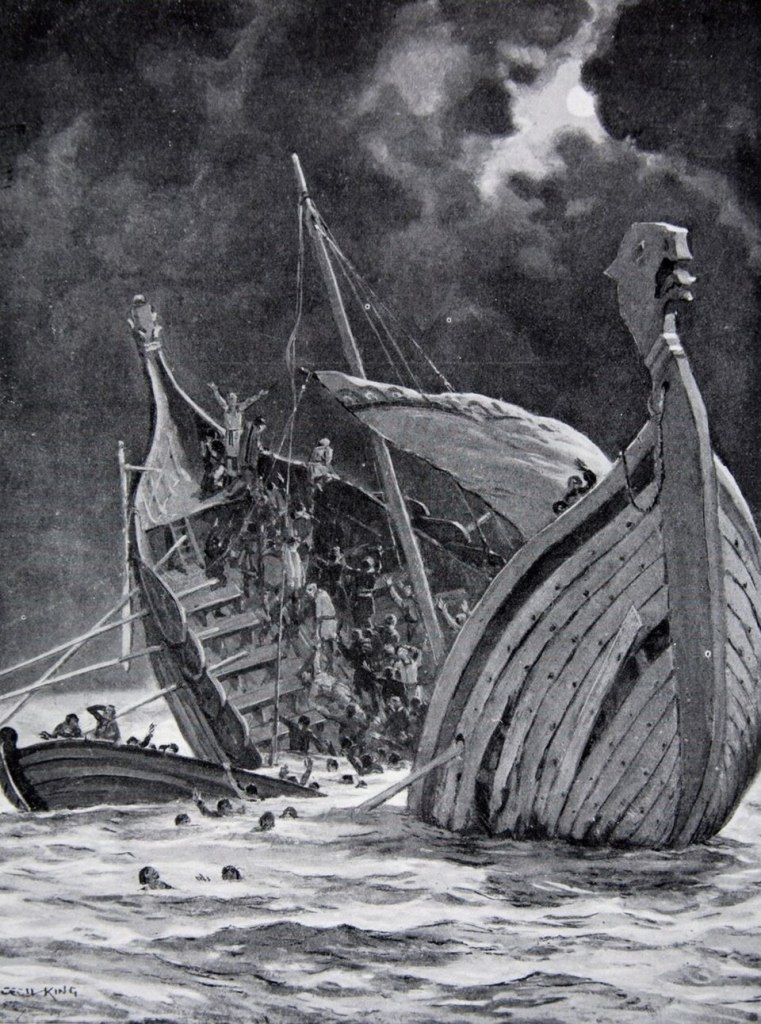
- That his ship was wrecked in a storm, causing him to drown.
Again, it is difficult to reach any robust or meaningful conclusion from these titbits. If Eadwine had risen in rebellion against his brother (still harbouring enmity since Ælfweard’s death, perhaps), then Æthelstan would have been within his rights to have his brother executed for treason.
Given that Eadwine was ‘obliged to leave’, however suggests one of two things:
- Either he was sent into exile – a surprisingly magnanimous move if the king had been responsible for Ælfweard’s death
- Or he fled before he could be captured.
A more unsettling suggestion could be that Æthelstan planned for him to be drowned at sea – perhaps deliberately sending him into exile in a boat that was far from sea-worthy. In that way, he could be held blameless for his brother’s death if that ship was to founder.
Conclusion
The evidence – such as it is – is inconclusive. A decent case can be made for Æthelstan’s guilt or his innocence (making this a fantastic subject for the author of historical fiction). There’s certainly not enough to prosecute, let alone arrest the king in today’s parlance.
Personally, I like to think Æthelstan was not an evil fratricide and that any actions he may have taken against Ælfflæd’s sons were in reaction to their apparent treachery. I’d support this stance with two further points.
- Æthelstan appears to have treated his two youngest brothers, Eadmund and Eadred, well. They appear as witnesses in his charters and we know that Eadmund fought alongside the king at the famous battle of Brunanburh in 937.
- Æthelstan never married or had any children that we know of. Hardly the actions of a power-crazed despot determined to pass the reins of power down his line. It has even been suggested – a line I take in my novel, in fact – that the price of overcoming West Saxon opposition to his rule was to agree to a life of celibacy so that the crown would eventually pass back to Edward the Elder’s remaining sons.


Leave a comment